Journal (To be young and beautiful)

Immortality is just the cherry on top of the cake, because in order to achieve the desired state of happiness, people not only want to live forever but also be young and beautiful, which is what the entire fashion and cosmetics industries, allied with the pharmaceutical industry, prey on.

I can understand that people during the Renaissance put on thick layers of make-up and wore wigs to hide the effects of syphilis, but when I see modern women, especially very young, even teenagers, powdered so much that it is difficult to tell what their facial features are because they look as if they were covered with plaster like a building façade, then I have a reflex of disgust. The same is true with perfumes. In the times when hygiene was a problematic matter, perfumes probably made sense, but now using a lift with someone drenched in Chanel No. 5 or whatever it is they used borders on torture, especially for a person like myself, endowed with a sensitive sense of smell. And these are only aesthetic impressions, although I doubt that make-up is really neutral for skin. But what about things that actually hurt, like shoes on high heels, botulinum toxin injections, or steroids used by bodybuilders?

When I watched Mothering Sunday with Odessa Young some time ago, the sight of her unshaven legs bathed in sunlight was a picture of absolute beauty (the film takes place in the interwar period, and the director Eva Husson paid attention to realism in detail). I have never been able to understand why women shave their legs, armpits, and pubic hair, especially since I sometimes see undesirable results in the form of rashes. Men don’t do this. And if I were a woman, I would spare myself the argument that they do it for men, because personally, being just an average guy, I like hair, and I’m certainly not alone in this. And if it’s a matter of some stupid fashion, maybe it’s time to change it?

Journal (It’s not me—it’s the world)

Montaigne said that as our birth brought us the birth of all things, so in our death is the death of all things included. But with that in mind, why would I trouble myself with death if it’s not me who died—it’s the world that ceased to exist? And shouldn’t those rather laugh at the end of this spectacle who cried at the beginning, especially if they might have already outlived their purpose?

Here, in the Western world, death has a particularly bad press—if mentioned at all—but you can’t avoid it if you ask about a happy life, since, to follow Ovid in Metamorphoses, we should all look forward to our last day: no one can be called happy till he is dead and buried (from The Essays of Montaigne—Volume 03 by Michel de Montaigne, translated by Charles Cotton). But sometimes, just like everyone else, I ask myself: Was—or is, as I’m still alive—my life a happy one? The problem is, I’m not even sure what that actually means—a happy life. I would say adequate. It’s like the dust on my desk—sometimes I wipe it off, but most of the time I get along.

We value human life exactly because it’s so frail and because it eventually ends—because of death. What would happen to that respect once death was gone?

Journal (Like attending Sunday mass)

An artist should either speak through art or not speak at all. How come? When I was returning from a walk on the beach, while passing the gallery in Castlegate, I noticed through the window that inside there was a group of people sitting on folding chairs, listening to a conversation between a slightly tense young host and a relaxed artist. The gallery walls were hung with images of roosters, which I assume were made by this very artist. I stopped, wondering whether to enter, but not wanting to cause unnecessary commotion, I decided not to. However, I stayed there to watch this gathering through the window for a moment, like a TV programme with the sound muted, especially since the glass reflected everything that was happening in the square behind me, so together it created an interesting composition. And then I saw her.

Her teenage face was marked with such obvious boredom that it was astonishing. I could see her because she was sitting at a certain angle, clearly not interested in the meeting that her parents sitting next to her had dragged her to, and playing with the pile of wristlets on her lap. At one point, she noticed me too and freaked out. The show was over. She pointed at me and whispered to her parents, who, of course, immediately turned towards me, but seeing that I was interested in the artist, they also went back to listening to him. To keep up appearances, I stood there a moment longer and finally decided to go my way.

But let’s return to our artist and the whole setup. I must admit, I have never understood this kind of gathering. Their artificiality seems so obvious that I cannot shake the impression that the only reason for taking part in them is snobbery or habit, like attending Sunday mass, even though the faith has long since faded and doesn’t rise above the façade. And isn’t it demeaning to the work of art if it requires the artist’s crutches in reception, assuming, of course, that the artist actually has something more than a handful of platitudes to say?

Journal (A sense of direction)

I just passed the professional certification exam required by my employer. It was my first exam since graduating, so, I won’t lie, I panicked a little because I was already out of practice, and the countdown clock in the corner of the exam application window didn’t help.

To be honest, I don’t like this type of exam where all that counts is the ability to memorise facts. I’ve never been good at this. I remember back in primary school, we had to memorise certain poems and recite them in front of the class for grades, and it was an absolute nightmare—not the recitation part but the memorization.

I learn best by gaining an understanding of the laws governing a given phenomenon, etc. In college, we had a chemical technology course where part of the curriculum was learning diagrams of chemical installations, such as oil refining, the production of nitrogen fertilisers, or certain acids. They were fairly complex, and I noticed students were divided into two groups: those who memorised a bunch of geometric shapes connected by lines, and those who learned the actual process shown in the diagram.

It’s not rocket science to guess who was better off. If someone from the first group was called to the blackboard to draw a diagram and they forgot any of the elements or confused the lines connecting them, they had no way to fix it because they had no idea what they were drawing. In contrast, if someone from the second group made a mistake while drawing, it all came down to following the process, and it quickly turned out that, for example, there was a pump missing between the tank and the furnace that heats the crude oil before it was fed to the distillation column.

And I guess it’s the same with life, where memorising the map is pointless if you don’t have a sense of direction.

Journal (The power to cause harm)

Does Suella Braverman—by claiming that multiculturalism has failed—suggest that we should all subscribe to some manufactured by the likes of her image of Britishness? Because even if I tried to fit that delusion, I have a really hard time guessing what that actually is I was supposed to become since, after seventeen years here, in the UK—in Scotland, to be more precise—I’d say there’s no such thing as British, at least where I live, and if you ask any random Aberdonian on the street who they are, you’ll most likely hear Scottish. I’m pretty certain the same applies to Wales and Northern Ireland, although the situation in the latter is way more complex. Even in England, people are still likely to call themselves English first rather than British (a lot depends on how you phrase the question).

Coming from a country that went through half a century of totalitarianism, I always feel an unpleasant shiver running down my spine when I hear a politician, especially a representative of the government who controls the security services and the police, utter such bold statements. They should know better that such words have the power to cause harm, which is why I’m horrified that she says them so casually, or in fact, uses them at all.

There is a saying in my native language that overzealousness is worse than fascism, and I’m afraid it fits this situation perfectly. I will keep Braverman’s words in mind next time I watch V for Vendetta, which has been my tradition every fifth of November for quite a few years now.

Journal (Till hell freezes over)

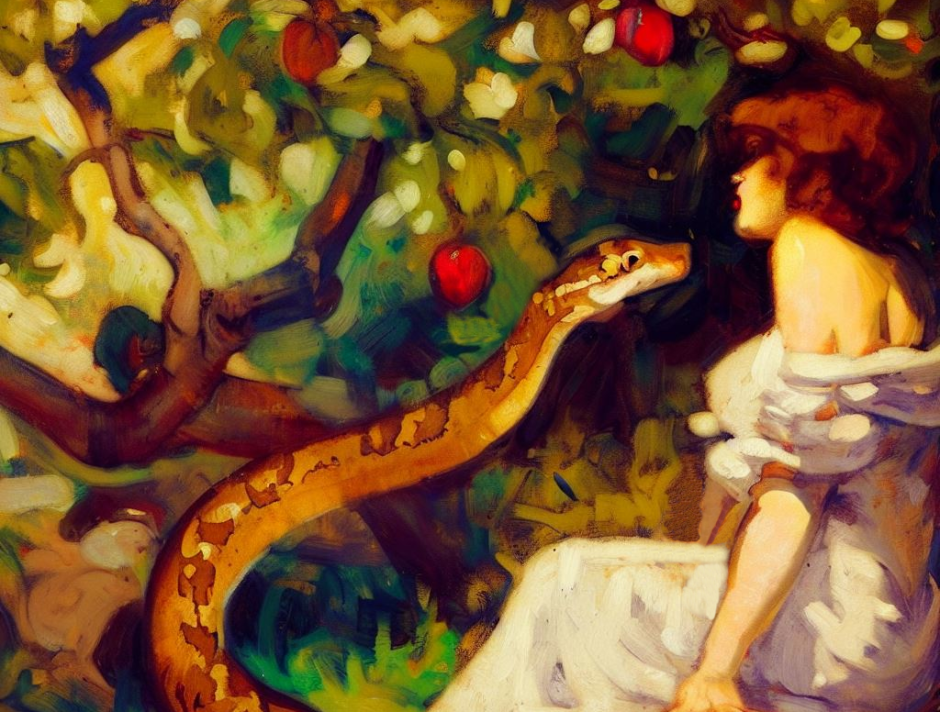
As I said earlier, what a disappointment it must have been to discover that someone else, that is, a woman, had suddenly appeared in the Garden of Eden. But I guess disappointment would be an understatement, to say the least. It probably looked more like a panic attack, triggering a state of emergency that has continued ever since. This required a solution, something fundamental that would safeguard the man’s position till hell freezes over—and hell it was; as once used, it quickly proved to be the best shackles and gag. And it doesn’t matter whether you call her Pandora, Eve, or Mary—no, not that one but Ms Wollstonecraft—your accusing finger says it all.

Journal (The only one)

What a disappointment it must have been to discover that someone else had suddenly appeared, whose very existence undermined one’s uniqueness amongst the many creatures in the Garden of Eden. Imagine no longer being the only one of one’s kind—the king of utopia, the sole proprietor of the realm of plenty, ill-equipped to leave the bliss of la-la land. Imagine being a man.

Journal (When’s the day)

Ever since I first spotted it on a billboard, I’ve always wondered if life truly was a fatal sexually transmitted disease. But cheer up. Nothing like A Bit of Fry and Laurie in “when’s the day”—I mean, Wednesday—evening, to be precise—after, started with the obligatory good morning, all day of hordeing at work to earn your fiver for a pint of bread—I mean a loaf of lager—I mean … You know what I mean. Well, except for the fact that your own bathroom light switch was just trying to electrocute you. But that would finally solve the dilemma, wouldn’t it, or at least dump it on some other poor bastard’s head? There is an endless supply of us, I can promise you that. So, cheers, my friend.

Journal (Could I write music?)

If I taught myself musical notation, would I be able to write music even though I can’t play any instruments? One might say, What a completely ridiculous idea—it’s like asking if, once you learn the alphabet, you could write Long Day’s Journey Into Night, In Search of Lost Time, or The Love Song of J. Alfred Prufrock. But is it really? I know, I’m not a bloody Shakespeare, and I wasn’t suggesting that I would attempt to write a new Hamlet. The thing is, there are times when melodies come to my mind, and I hum them to my internal pleasure, but they are gone soon after. If only I wrote them down to be able to come back to them at a later time, who knows what they might evolve into? After all, even though I’m not even remotely close to being at the level of T. S. Eliot, I managed to write a few fairly decent poems. Of course, assuming I don’t have dysmusia.