On the way to the lighthouse, there is a playground that I pass during my evening walks.
It’s usually empty at this time of day, but sometimes I see teenagers vaping or old people
chatting while walking their dogs. That particular evening, there was a family with three
huskies there—a little boy spinning on a carousel, his father throwing sticks for the dogs
to fetch, and his mother sitting on a bench with a baby. A beautiful genre scene, one might say,
except that at one point one of the dogs, running past the carousel, unexpectedly bit the boy.
You can imagine the terrified boy screaming, and it took his father a while to calm him down.
And here is the thing—it was their family dog. What would happen if it were a stranger’s
and something like American Bully XL? More importantly, if the police found me carrying
a pocket knife only slightly longer than three inches, that would be a criminal offence,
but walking around with over a hundred pounds of muscle and fangs on the loose is just fine.
I like the logic behind that.
Tag: poem
When I was a boy
“When I was a child, I spake as a child, I understood as a child, I thought as a child:
but when I became a man, I put away childish things.”
1 Corinthians 13:11, The King James Bible
When I was a boy, I stuttered. It took a while,
but with each new wrinkle and extra mile away
from home, my voice finally began to smooth out.
And though I’m fine now, every now and then
it comes back, often when I’m nervous.
When I was a boy, chairs always made me uneasy
because they had the power to fly across the leaving room.
That’s probably why I’ve always had a fondness
for those big old armchairs with a headrest
and leather upholstery, like the one in grandpa’s study.
When I was a boy, twice a week after school,
my parents would send me to religious classes
in the new catechetical house, the pride of the town.
Only there did I dream of being the Antichrist,
so I had the power to turn wine into water.
No need for rain when no one cries
I bought this fancy camera once, only to lose interest in photography.
Some other time, I spent hours rehearsing small talk and still chose solitude
like every other hermit among the city dwellers. And since I’m bookish,
I knew marginalia were my bread and butter, but one way or another
I had to face the question: Do I lose interest in everyday life?
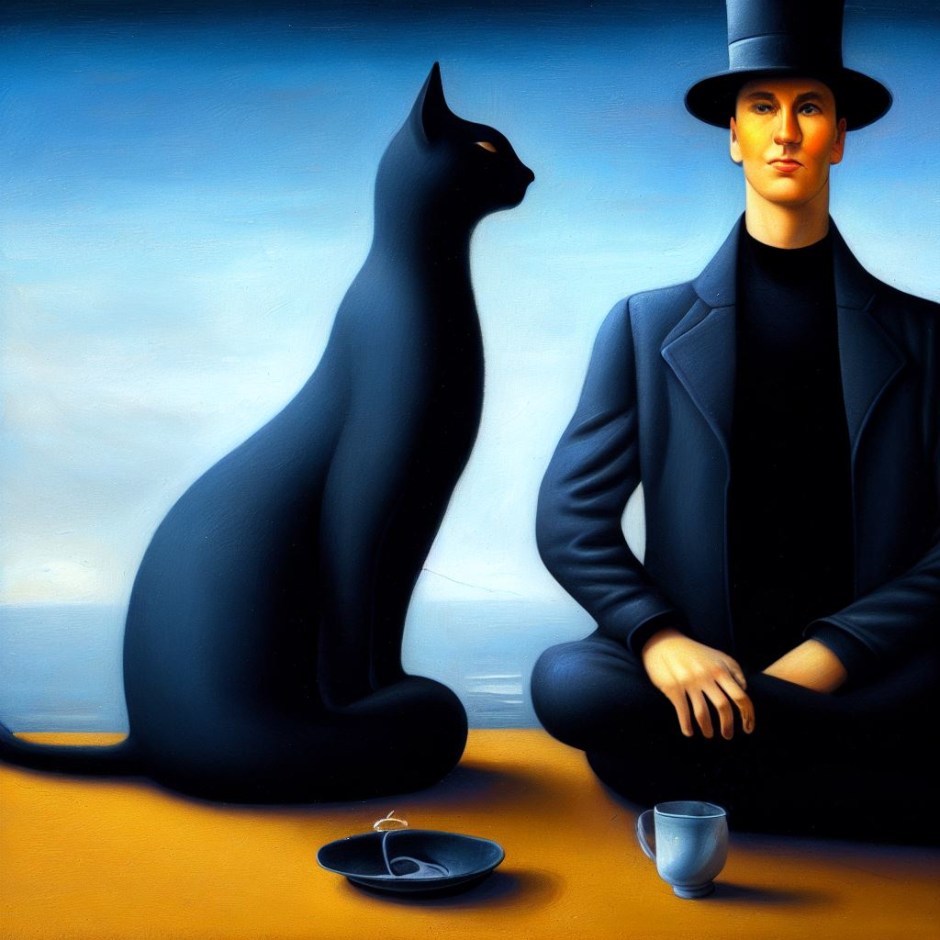
Then again, like a faceless man in a bowler hat, every now and then I think
that I’ve actually caught a glimpse of something—I just don’t know
what exactly it is yet—but it always turns out to be nothing
but my imagination.
To be the last
They never asked to be the last living person
to witness what happened, or maybe just visit
or see the Twin Towers in person, even if only from afar,
and perhaps would prefer to remain in the shadows,
away from the uninvited attention of politicians and the media,
but one day, there will be someone like that, for sure.
One day, even New Yorkers will think of 9/11
no more than we think of Verdun or the Somme,
and eventually, there will be only a handful of experts,
like with the Achaemenid destruction of Athens.
For now, while the scars are still fresh,
let’s try to avoid the mistakes of a hundred years ago.
Remember, the Great War was to be the last.
Victims
It must have been something important
that, as a reporter on duty, I was on a bus
to visit some family in trouble,
and yet I can’t recall what it was.
All I remember is that when I arrived,
the planes had already crashed into the Twin Towers,
and instead of talking, we sat in silence
in front of the TV in their living room.
Then the editor called my mobile to come back
to the newsroom immediately, and that was it.
Their faces, names, and even the name of the town
have long since faded from my memory.
I don’t know if anyone got back to them eventually
to help with whatever it was that troubled them.
I guess, in a sense, they were victims too,
even if all they could ever get
was this feeble memorial.
A special day
Saturday was a special day—a bath day for Sunday.
We stood by the washtub placed next to the well,
watching our mother pour hot water from the cauldron
and then add cold well water, stirring to obtain the right temperature.
Then she would take each of us in turn and bathe thoroughly
from head to toe with quick moves and without fuss,
dry with a towel, and help get dressed.
I don’t really remember that. It’s just one
of the very few stories from back then that she ever told us.
Saturday was a special day—the day I’d like to believe
we felt like family.
What name do you wear to dinner?
I never liked my name. It sounds wishy-washy, to be honest,
and definitely lacks the solid attitude of Piotr or Janusz.
Even my middle name has more to offer in this regard.
And why do we attach so much importance to the name
in the first place? What’s wrong with changing it like we do
with our hair or clothes? Our bodies, not to mention minds,
also change over time, so why stick with the same name for life?
Maybe tomorrow I will wake up feeling like Aditya or Haruto,
or better yet, Gwendolyn, to express my feminine side.
And why limit ourselves to calendar pages? Don’t we change
out of our morning sweatpants into work clothes, and after
returning home, into something more appropriate for dinner,
finally slipping into our pyjamas at the end of the day?
And if a name is indeed at the core of our personality,
then building it on a foundation that is merely the accidental
whim of our parents on our birthday seems somewhat unwise.
Anyway, right now, I feel like nobody—Mr. Nobody.
In the hour of my death
In the hour of my death, I did something insignificant,
as I often would. A book fell to the floor, bending the pages,
which I never liked. A stillborn note cut off mid-sentence
never got a chance to become a stanza. A cup of tea gone cold
and a half-eaten cookie—not even a madeleine—that at best
could remind someone of my cholesterol problems were waiting
to be thrown away. Only the clock, as always, marked the passing
moments with its regular tick-tock. In the hour of my death,
I did something insignificant because, in the end, I was taken
by surprise again.
Imagining nothing
Sometimes I write words. Most of the time, I write
nothing, and I know it’s just the way English grammar works,
but still, that substantiation of nothingness is truly baffling.
And I’m not talking about vacuum, which, by the way,
is no longer equated with nothing in modern science;
not even about être-pour-soi, the nihilation of être-en-soi,
but about the true nothingness—the unimaginable.