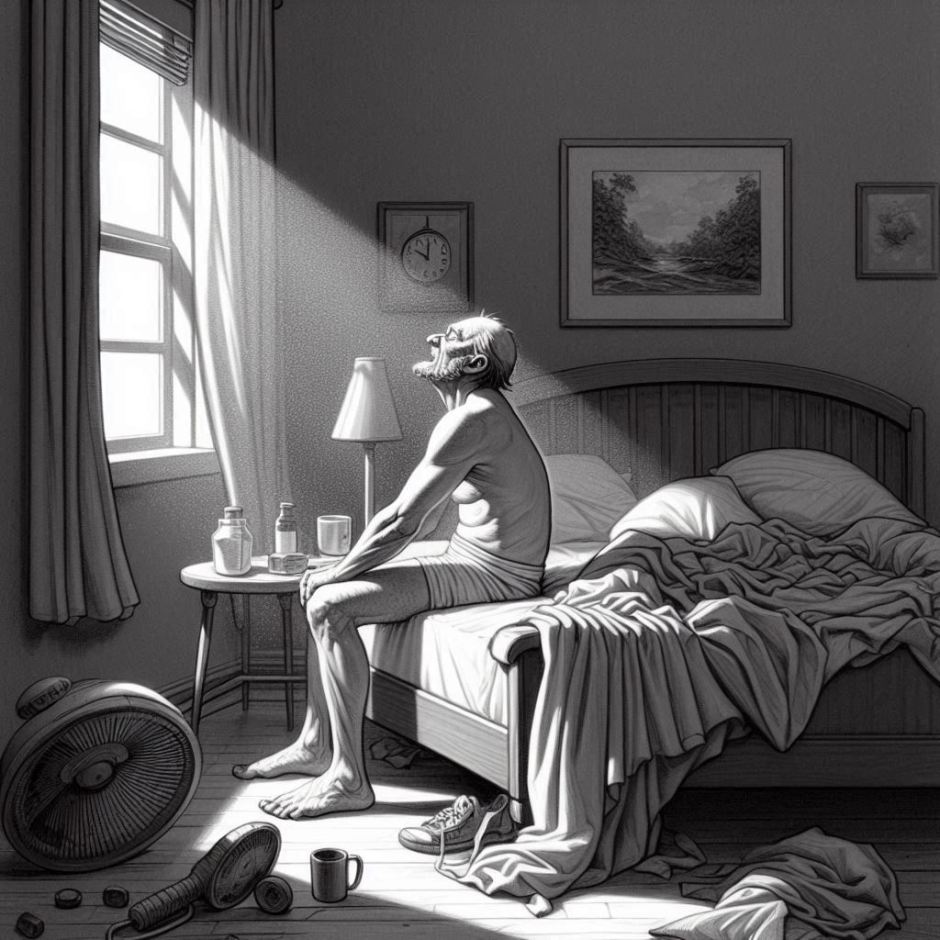
Being whimsical in the age of saviours

Is being remembered really that important, you ask,
and yet the very fact that you wrote it down for others to read
belies its premise—and how long has it been since I lost
my innocent eyes that knew no doubt
whether to pursue the preoccupied with iambic metres
scattered across the yesterdays of enlightened fools
diving barefoot into the grass of the night lea?

You once told me that the intrepid look straight
and master all the right words, unlike us, the fickle.
We are a peculiar breed, creatures of timid vocabulary
who prefer an accidental graze, an answer cut off halfway,
and a picture taken with a wink. And we hardly ever cry,
but when we do, it’s probably because we missed the rain,
as if it all came down to the umbrella stuck in the rack.

Apart

I only chop onions when I’m blue, and it’s not a rainy day
to go for a walk without an umbrella. I am a man, after all,
even if no one expects me to keep up appearances anymore.
And I suppose belief in constellations was a hallmark of youth
until one night we looked up at the northern sky and realised
that even the closest stars were light years apart—without fear.

Watching from the sidelines

Life always seemed to be outside the realm of our expertise,
and as unrepentant as one can be, we thrived on the idea
that any seemingly genuine feeling other than all the anguish
that one could muster would turn out to be nothing but a façade,
so instead we have been collecting stains since time immemorial
and, ever eager for a gaze into the abyss, continue to do so.
But what’s most bizarre is that we truly intend to celebrate
our forlorn retirement as if we were mere spectators
in this panopticon.

The game of colours

What are the odds of getting one double-yolk egg,
let alone a whole box? One in a thousand, I read,
and yet the latter happened to me just the other day.
You have to admit, I must be one lucky bastard
or an unlucky one, depending on the superstitions
we follow. Speaking of which, I have always wondered
why blue is considered better than red and white imposes
its supposed supremacy over black, brown, and yellow.
After all, in the game of colours, nothing lasts but the dire
shades of pale.

The shadows

The shadows outside my bedroom wear names other than mine,
but at least we still share the sentiment of having one.
Also, we all measure time, although I’m not particularly fond
of manipulating it, even if only twice a year.

The shadows outside my bedroom are keen on collecting proverbs,
as they look good pinned in a display box on the wall.
Well, as long as guests don’t mind the smell of naphthalene
and glossy reddish-brown stains on the pinning stage.

The shadows outside my bedroom preach kinship with the sun
yet practice fluttering around the glowing, coiled filament of tungsten
I come from. Sometimes I wonder if, behind closed curtains,
they simply cease to exist.

Reality

Nothing is real but reality in a watercolour
fog washed with the secretions of the graveyard
shift, like the yawner’s mention of a scarlet dawn.
Is it the fool moon mocking the street lamps
with reflected light that holds terror for one,
or is it the crunch of pebbles with each tired step?
And while the outline of meals has long lost its meaning,
they are still necessary to keep up appearances.
After all, any of them could be supper.

A rude awakening

In the river of yellow umbrellas,
the rain swims with frantic crawls,
as if plotting wet shoulders were barely enough.
But even if the sky forgives the reflection
and the wind forgets the manner,
once they learn that forever has a pretty short shelf life,
they will realise all that’s left is to count
the grains of sand stolen from an hourglass
and be cautious.

Journal (The sound of the waves)

What do you do when you realise you are not going to be a great poet one day? After thirty years of writing poetry, you finally give up, make a note of it in your journal, and move on. Simple as that. After all, there is more to life than putting together a stanza, even a great one. And if, in your case, it’s decent at best, what’s the point? Instead of wasting hours in your room trying to find the right onomatopoeia, wouldn’t it be better to listen to the sound of the waves while walking on the beach?

Journal (There were never so many poetasters as now)

“Since Ronsard and Du Bellay have given reputation to our French poesy, every little dabbler, for aught I see, swells his words as high, and makes his cadences very near as harmonious as they: ‘Plus sonat, quam valet.’ [‘More sound than sense’—Seneca, Ep., 40.] For the vulgar, there were never so many poetasters as now; but though they find it no hard matter to imitate their rhyme, they yet fall infinitely short of imitating the rich descriptions of the one, and the delicate invention of the other of these masters.” (from The Essays of Montaigne—Volume 05 by Michel de Montaigne, translated by Charles Cotton)

Reading his words, I wonder what Montaigne would say about the state of poetry in our times, as not only has it evolved in form but it has also democratised, and today in France alone, probably more people write poetry than were educated in that country in his time. But reading this passage, I feel that they are as relevant now as they were then. If I happen to stumble upon a poem, especially one published online, I almost never find any satisfaction in reading it, let alone being impressed, and that’s also why I’ve stopped writing poetry myself. But enough about that because the sun finally came out after the storm Babet, so it’s time to go outside.