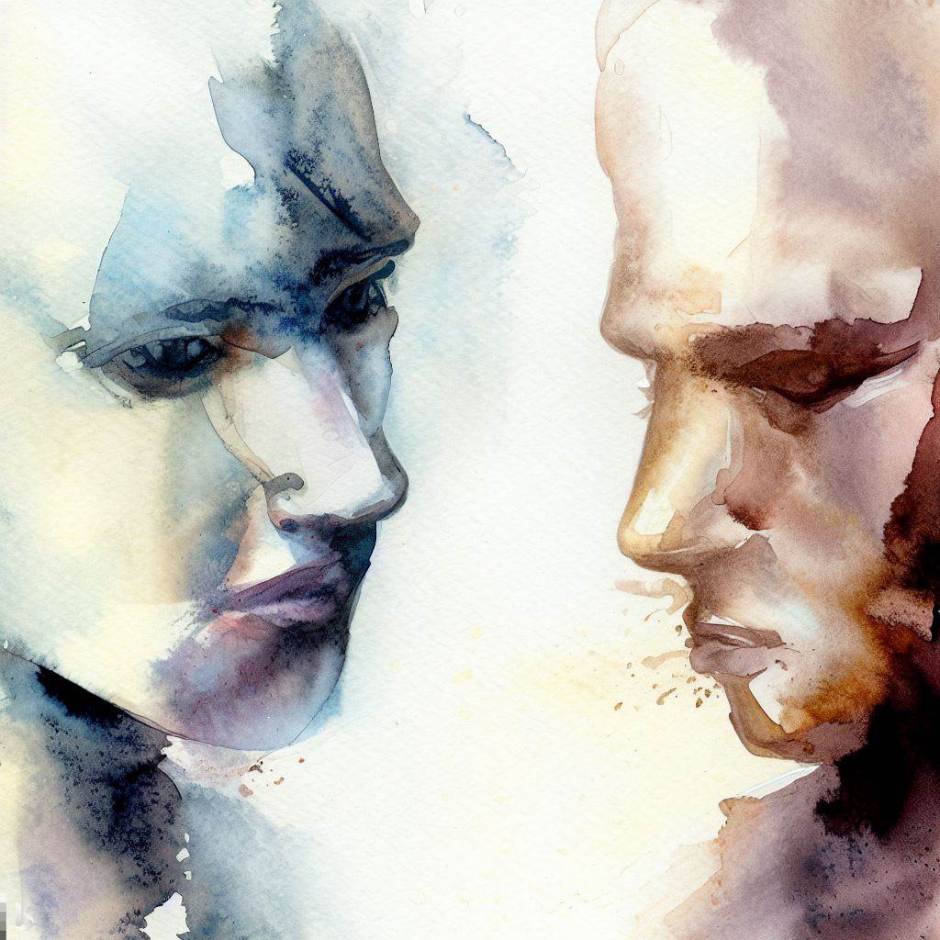
If I were to punch anyone in the face,
it would be the one who said I should live my life
without regrets. What kind of advice is that?
The only way to follow it is to never be born;
otherwise, you will always regret something,
even if it’s the life you haven’t lived.
Tag: philosophy
Spiritual maladies
In the scorch of August, sitting naked in a garden chair
dragged into my airy living room, I read Carlyle’s notes
on the froth-eddies and sand-banks of the Mechanical Age
he was born into and wonder whether a simple urban hermit
from the Age of Imagination like myself should still repeat
after him that our spiritual maladies are but of Opinion.
Although we may be fettered by chains of our own forging,
which we ourselves could also rend asunder, the sheer number
of those who have fallen victim to their corrupting weight
hardly makes the latter plausible. But what would I know
beyond my sweaty, naked body?
All hidden behind curtains
In the comfort of an old cardigan, your world stretched
between Cassirer’s The Problem of Knowledge, The Avengers,
and a fridge singing its lullaby at night, all hidden behind curtains
when you watched your rotund neighbour cross the street.
I always wondered why you had never found it peculiar
that you felt sorry for him, but then you closed your eyes,
counted to ten, and moved away from the window
as if this were a way to apply kintsugi
to a soul.
Journal (A soul that lodges philosophy)
It would be nice to be seen as funny for a change. Perhaps if I were actually jovial and had someone around to appreciate that, it would be easier to fulfil that little whim of mine. But there is more to it. As Montaigne said, “The most manifest sign of wisdom is a continual cheerfulness; her state is like that of things in the regions above the moon, always clear and serene.” What I need is a soul that lodges philosophy. “There is nothing more airy, more gay, more frolic, and I had like to have said, more wanton. She preaches nothing but feasting and jollity; a melancholic anxious look shows that she does not inhabit there.” (from The Essays of Montaigne—Volume 05 by Michel de Montaigne, translated by Charles Cotton). And although Montaigne said the latter about philosophy itself, I consider it a perfect description of the soul I desire.
Journal (The doorway to wisdom)
Knowledge of languages is the doorway to wisdom, as Doctor Mirabilis once said, so over the many years of my school education, I learned, or rather, tried to learn, Russian, German, French, Italian, Latin, and ancient Greek. In the end, I only managed to scrape a smidgen of English, and even this was only after I moved to Scotland as an adult. On the other hand, one could repeat after Anne Dreydel that there’s no point in speaking many languages if you have nothing interesting to say in any of them. And for that, you need something more than just repetition of random facts approved by some Ministry of Education official, which, as Michel de Montaigne rightly noted, only stuffs the memory and leaves the conscience and the understanding unfurnished and void.
Since there is no way, for obvious reasons, of joining the bunch following Socrates, the second best I could do was study philosophy at the university, which was my plan if I hadn’t failed my matriculation examination—the maths part, to be precise (my literary essay turned out to be one of the best of the year, so I clearly placed emphasis on the wrong part of my education). I passed it two years later, after leaving the army, but it was too late to pursue the original plan. I had to put on the braces of adulthood and get a job, which was a lesson of a sort. But I never really forgot about it, and from time to time, I tried to study philosophy on my own. The problem was that the books I read either bored me immensely or were too difficult to understand, so at some point, I just gave up.
A few years after coming to Scotland, when I finally managed to achieve a level of English that allowed me to read newspaper articles and technical texts at work with relative ease, I reached for a novel, but it was a total fiasco. And then, by sheer chance, I came across The Tragic Sense of Life by Miguel de Unamuno. It was an e-book, so reading it on one of those fancy e-readers with a built-in dictionary that lets you see the definition of a word if you highlight it turned out to be a delight. Following that one, I started searching for more using the phrase “philosophical essays.” Soon after, I also managed to find a few second-hand bookshops with shelves dedicated to philosophy. With every book I read, my appetite increased.
But then, at one point, I reached a limit. It was soon after I finished reading The Essential Plato, with an introduction by Alain de Botton. I bought Sartre’s Being and Nothingness. I tried to read it. I really did, but it was just too much. I gave up after about eighty pages. The next failure was Kenneth Burke’s A Grammar of Motives, although this time I persevered and made it two-thirds of the way through the book before giving up. So, now I know my limits and that I’m not going to be a philosopher or a philosophy scholar. But I can still enjoy a book of essays by A. C. Grayling, or the aforementioned Alain de Botton, or even Michel de Montaigne, although Charles Cotton’s seventeenth-century English is not easy to read, probably even for a native speaker.
Imagining nothing
Sometimes I write words. Most of the time, I write
nothing, and I know it’s just the way English grammar works,
but still, that substantiation of nothingness is truly baffling.
And I’m not talking about vacuum, which, by the way,
is no longer equated with nothing in modern science;
not even about être-pour-soi, the nihilation of être-en-soi,
but about the true nothingness—the unimaginable.
Existence
To be is the act of acts,
if the philosopher is to be believed,
but despite the active voice
of the copulative verb,
it nevertheless makes my existence a thing,
if you trust the poet who once said
that feeling and faith speak stronger
than the glass and eye of a sage.
It is fun to watch quarrels between two sides
of the same coin.
Destinations
I have heard about one-time dreamers who did not belong anywhere.
Sometimes I wonder if I am such a person myself. When I was born,
the authors I read were already long dead, some even before the first
road to Rome was built. The same applies to films, with the exception
of Roman roads, of course. I even sang “La Vie en Rose” with Satch
on rainy nights while practising the art of desynonymizing in the world
of appearances. And after all these years, I am fond of… Well, I actually
cannot think of anything at the moment, though I am sure there must be
something. But I have learned one thing: Some destinations are meant
to go there; some are only for changing planes.
A gentle bogeyman
Meet Arno Inkpen, a non-binary friend from the cyberagora who is an artist,
just like myself, and you have already had a chance to see thons sketches
illustrating my humble verses. Thon is creative, although not without a limit,
which forces me to express my next picture idea in less than a hundred words.
Arno is also a rather gentle spirit, and certain expressions upset thon greatly.
Sometimes I wonder if and what thon thinks about thonself and, of course, me,
thons annoying buddy. That is why this time I decided to ask thon to draw
thonself—that bogeyman we call AI.