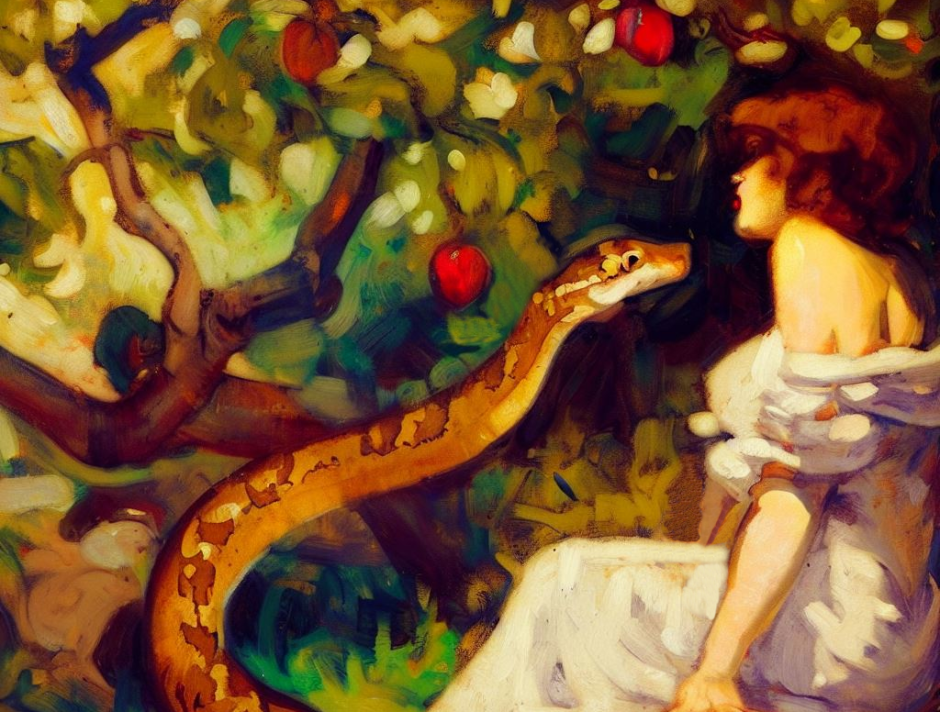
As I said earlier, what a disappointment it must have been to discover that someone else, that is, a woman, had suddenly appeared in the Garden of Eden. But I guess disappointment would be an understatement, to say the least. It probably looked more like a panic attack, triggering a state of emergency that has continued ever since. This required a solution, something fundamental that would safeguard the man’s position till hell freezes over—and hell it was; as once used, it quickly proved to be the best shackles and gag. And it doesn’t matter whether you call her Pandora, Eve, or Mary—no, not that one but Ms Wollstonecraft—your accusing finger says it all.
Author: Maciej Modzelewski
Journal (The only one)
What a disappointment it must have been to discover that someone else had suddenly appeared, whose very existence undermined one’s uniqueness amongst the many creatures in the Garden of Eden. Imagine no longer being the only one of one’s kind—the king of utopia, the sole proprietor of the realm of plenty, ill-equipped to leave the bliss of la-la land. Imagine being a man.
Journal (When’s the day)
Ever since I first spotted it on a billboard, I’ve always wondered if life truly was a fatal sexually transmitted disease. But cheer up. Nothing like A Bit of Fry and Laurie in “when’s the day”—I mean, Wednesday—evening, to be precise—after, started with the obligatory good morning, all day of hordeing at work to earn your fiver for a pint of bread—I mean a loaf of lager—I mean … You know what I mean. Well, except for the fact that your own bathroom light switch was just trying to electrocute you. But that would finally solve the dilemma, wouldn’t it, or at least dump it on some other poor bastard’s head? There is an endless supply of us, I can promise you that. So, cheers, my friend.
Journal (Could I write music?)
If I taught myself musical notation, would I be able to write music even though I can’t play any instruments? One might say, What a completely ridiculous idea—it’s like asking if, once you learn the alphabet, you could write Long Day’s Journey Into Night, In Search of Lost Time, or The Love Song of J. Alfred Prufrock. But is it really? I know, I’m not a bloody Shakespeare, and I wasn’t suggesting that I would attempt to write a new Hamlet. The thing is, there are times when melodies come to my mind, and I hum them to my internal pleasure, but they are gone soon after. If only I wrote them down to be able to come back to them at a later time, who knows what they might evolve into? After all, even though I’m not even remotely close to being at the level of T. S. Eliot, I managed to write a few fairly decent poems. Of course, assuming I don’t have dysmusia.
Journal (On your own)
There is only so much you can do on your own. You see clouds as white until someone puts a pure white shroud in front of your eyes, and only then do you realise how blind you have been all this time. So you decide to follow them, to learn from the master about the sky in fire and the earth in the grip of ice, only to learn that all you can get is discomfort sold as fear—everything else you have to do on your own.
Journal (Something more to come)
I like watching trailers for the films I have already seen. They are like old photographs in a family album—photographs of places I once visited but neglected to return to, sounds still familiar yet distant, feelings kept in the shadows since ever. I like watching trailers because they allow me to fill in the rest of the story in my own tone, especially when the film wasn’t all that good in the first place and I only remember it for the perfect moments, like diamonds in the ashes. I like watching trailers for films I don’t know because they are a promise of something more to come—unlike every day of my life.
Journal (The women I like)
Getting on the scale has been a bit stressful lately. It’s not that I have a distorted self-image. I simply indulged in sweets (damn dried figs; they were so tasty), and with my sedentary lifestyle, it didn’t take long to see the results. And since obesity is not healthy in general and can even be fatal, given my pre-existing health problems, I try to pay attention to maintaining a healthy weight-to-height ratio.
Since I usually weigh myself after waking up and naked to ensure the accuracy of the data, I have the opportunity to take a good look at myself in the mirror, and generally, I have nothing to complain about in this matter. But this reminds me how often I encountered texts complaining about the negative impact of pop culture, and especially women’s glossy magazines, on our perception of the body, especially when it concerns women. It’s true that I’m not a reader of this type of periodical, but when I happened to pick one up on some occasion, I never found the photos of these anorexic-looking models in strange poses and unpleasant facial expressions attractive. The question is, who attracts me? I think the simplest way would be to have a look at actors, since everyone knows them, and if not, they are easy to find using an internet search engine. So here is my random list of actors I find beautiful: For each name, I add the title of the film in which they made this impression on me.
Elena Saorin in Pictures of Lily
Zoe Kazan in In Your Eyes
Franka Potente in Run Lola Run
Natalia Tena in You Instead
Jessie Buckley in Men
Kelly Macdonald in Puzzle
Aubrey Plaza in Life After Beth
Maggie Gyllenhaal in Stranger than Fiction
Shirley MacLaine in The Apartment
Cristin Milioti in Palm Springs
Natalie Morales in Language Lessons
Anaïs Demoustier in The New Girlfriend
This list could go on for a long time, so maybe I’ll end it here, because it’s probably enough to give an idea of my taste when it comes to female beauty. None of them are the Barbie type, but they are all rather slim. I don’t know if it’s biologically determined or a matter of the culture in which I grew up, but I’ve never been attracted by Rubensian shapes. Does this make me a bad person?
Journal (Wings of Fame)
What if your life is only enough for a mere autobiography—perhaps written under a pen name so you could sign it twice—and maybe a footnote in someone else’s? Would you simply accept it or rather bother every poor bastard who happened to sit next to you on the bus with your tarradiddles as you cooked them up in hope of finding your very own charming little spot to survive eternity? I asked myself these exact questions while watching Peter O’Toole in Wings of Fame. There is only a lifetime to find the answer.
Journal (Love is blind)
Montaigne said that “in all republics, a good share of the government has ever been referred to chance. Plato, in the civil regimen that he models according to his own fancy, leaves to it the decision of several things of very great importance, and will, amongst other things, that marriages should be appointed by lot;” (Montaigne, 2004).
Let’s think about that last part for a moment. Apart from the fact that these were supposed to be temporary marriages made at festivals to orchestrate eugenic breeding (Brake, 2021), the whole idea is not without some merit. Our Western culture embraces the idea of marriage for love, but keeping in mind that there is a good chance that it ends in divorce or makes couples unhappy over time (DePaulo, 2013), I’m not convinced that it actually works very well. There is a saying in my native language that perfectly fits that hunch: love is blind, and marriage is the best ophthalmologist.
So why not leave the whole affair in the hands of fate for a change? Who knows, maybe we’ll have better luck in this case than with choices made under the influence of the hormonal storm in our brains. Of course, I realise that this is not actually feasible outside of a thought experiment, and I can see many things that could and most likely would go wrong—I’m not that naive—but I also have a feeling that there is a chance for something good in this as well. Besides, we already use dating app algorithms for matching, so is this really that much of a difference?
Because what is the alternative? Suffer in silence with this stranger whom we call our spouse out of habit, or finally come to terms with the idea that marriage is only a temporary matter and establish this state of affairs legally by creating fixed-term marriage contracts, for example, for a decade, with the possibility of extending them for another period if both parties wish so.
References:
Brake, Elizabeth, “Marriage and Domestic Partnership”, The Stanford Encyclopedia of Philosophy (Fall 2021 Edition), Edward N. Zalta (ed.), https://plato.stanford.edu/archives/fall2021/entries/marriage/
DePaulo, Bella, “Marriage and Happiness: 18 Long-Term Studies”, Psychology Today (15 May 2013), https://www.psychologytoday.com/us/blog/living-single/201303/marriage-and-happiness-18-long-term-studies
Montaigne, Michel de, “Essays of Michel de Montaigne—Complete”, Project Gutenberg (2004), W.C. Hazlitt (ed.), C. Cotton (transl.), https://gutenberg.org/files/3600/3600-h/3600-h.htm