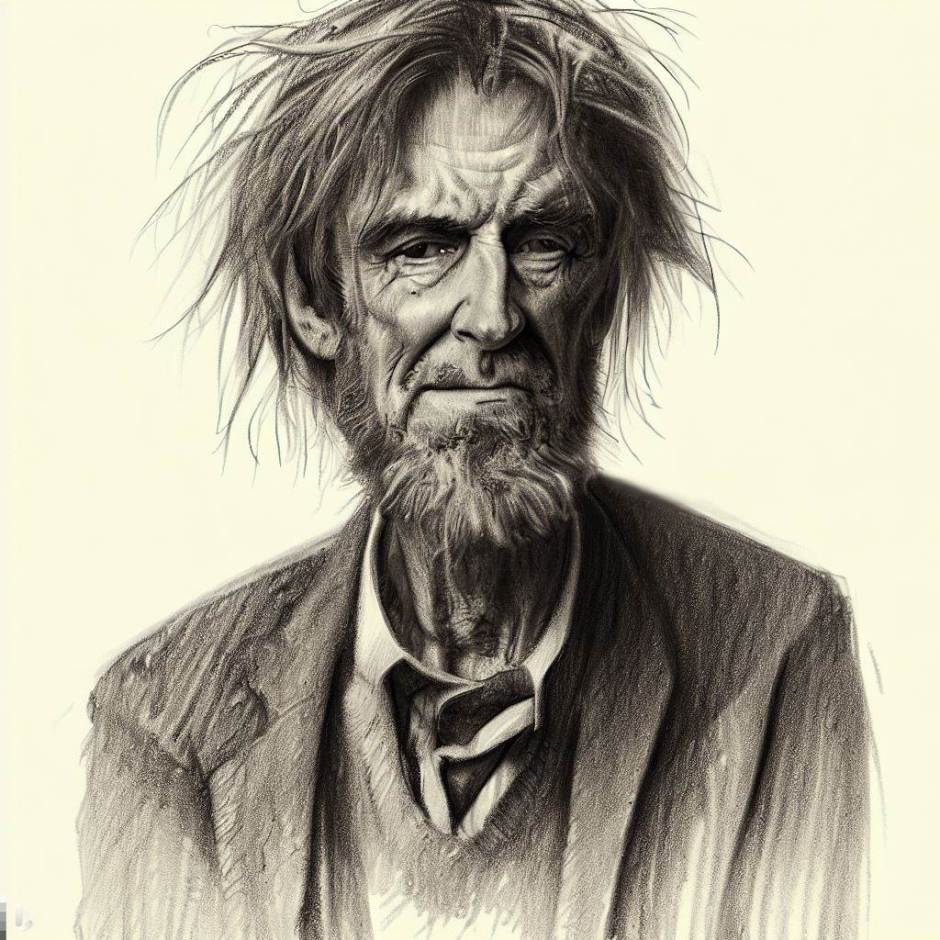
Reading the Apology

[…] not by wisdom do poets write poetry, but by a sort of genius and inspiration; they are like diviners or soothsayers who also say many fine things but do not understand the meaning of them.
Plato, Apology

Although not without its jocosities,
as well as its tragedies, life is mostly filled
with a farrago of inconveniences,
so, with a soft spot for magpies,
while mastering the implements
of idle chatter and flamboyance of gesture,
being the reserved ignoramus I am, I shrug
in front of it, just as I did
when I first met Platocrates—
not with resentment but relief.
After all, he gave me a dispensation
from intellectualism.


More words to ponder at maciejmodzelewski.com

The wisdom in a yawn

Sitting by the window, in the last rays of evening light, I read
the words of one man asking another again and again how long
he will delay to be wise.

The question, though asked in the second person singular,
could not possibly have been addressed to me, for I am a poet,
and we all know the ‘Apology.’

So who is that individual our sage is so insistently enquiring?
Would it be the normal London plumber plotting some infernal
hole among the roofs?

Whoever he is, I hope he is not yawning as hard, though of course
one can always blame the weather, for today it’s raining cats and dogs,
and that always puts me to sleep.

Journal (A soul that lodges philosophy)

It would be nice to be seen as funny for a change. Perhaps if I were actually jovial and had someone around to appreciate that, it would be easier to fulfil that little whim of mine. But there is more to it. As Montaigne said, “The most manifest sign of wisdom is a continual cheerfulness; her state is like that of things in the regions above the moon, always clear and serene.” What I need is a soul that lodges philosophy. “There is nothing more airy, more gay, more frolic, and I had like to have said, more wanton. She preaches nothing but feasting and jollity; a melancholic anxious look shows that she does not inhabit there.” (from The Essays of Montaigne—Volume 05 by Michel de Montaigne, translated by Charles Cotton). And although Montaigne said the latter about philosophy itself, I consider it a perfect description of the soul I desire.

Journal (The doorway to wisdom)

Knowledge of languages is the doorway to wisdom, as Doctor Mirabilis once said, so over the many years of my school education, I learned, or rather, tried to learn, Russian, German, French, Italian, Latin, and ancient Greek. In the end, I only managed to scrape a smidgen of English, and even this was only after I moved to Scotland as an adult. On the other hand, one could repeat after Anne Dreydel that there’s no point in speaking many languages if you have nothing interesting to say in any of them. And for that, you need something more than just repetition of random facts approved by some Ministry of Education official, which, as Michel de Montaigne rightly noted, only stuffs the memory and leaves the conscience and the understanding unfurnished and void.

Since there is no way, for obvious reasons, of joining the bunch following Socrates, the second best I could do was study philosophy at the university, which was my plan if I hadn’t failed my matriculation examination—the maths part, to be precise (my literary essay turned out to be one of the best of the year, so I clearly placed emphasis on the wrong part of my education). I passed it two years later, after leaving the army, but it was too late to pursue the original plan. I had to put on the braces of adulthood and get a job, which was a lesson of a sort. But I never really forgot about it, and from time to time, I tried to study philosophy on my own. The problem was that the books I read either bored me immensely or were too difficult to understand, so at some point, I just gave up.

A few years after coming to Scotland, when I finally managed to achieve a level of English that allowed me to read newspaper articles and technical texts at work with relative ease, I reached for a novel, but it was a total fiasco. And then, by sheer chance, I came across The Tragic Sense of Life by Miguel de Unamuno. It was an e-book, so reading it on one of those fancy e-readers with a built-in dictionary that lets you see the definition of a word if you highlight it turned out to be a delight. Following that one, I started searching for more using the phrase “philosophical essays.” Soon after, I also managed to find a few second-hand bookshops with shelves dedicated to philosophy. With every book I read, my appetite increased.

But then, at one point, I reached a limit. It was soon after I finished reading The Essential Plato, with an introduction by Alain de Botton. I bought Sartre’s Being and Nothingness. I tried to read it. I really did, but it was just too much. I gave up after about eighty pages. The next failure was Kenneth Burke’s A Grammar of Motives, although this time I persevered and made it two-thirds of the way through the book before giving up. So, now I know my limits and that I’m not going to be a philosopher or a philosophy scholar. But I can still enjoy a book of essays by A. C. Grayling, or the aforementioned Alain de Botton, or even Michel de Montaigne, although Charles Cotton’s seventeenth-century English is not easy to read, probably even for a native speaker.

Damage limitation

Perhaps I will leave saving the world
to greater minds and braver spirits.
I am not cut for profundity, too meagre
to become a hero, and clearly lack
the necessary charisma to inspire others.
There has always been something
missing in my constitution
that prevented me from even approaching
the depths of the sages’ wisdom
I desperately desired.
And since I cannot pave new paths,
all that remains is to limit damage
within the existing ones, at least
in my own backyard.

The implied wisdom of my age

They say that with age comes wisdom. Perhaps, but how can I be certain?
What I do know for sure is that with age comes nocturia, high cholesterol,
and a bad temper, although in fact I was grumpy even before I got older.
Touch wood, I am mobile and keep up with my work. But I have also lost
my inclination to claim the source of all earthly goods that we endlessly
pursue. Because who needs cornucopia in the age of waste-defined plenty,
where even the ever-reinvented trinity of ubertas, veritas, and auctoritas
gravitates towards mockery?