Journal (Tsundoku)

Why do we collect books? For reading, obviously, but sometimes also to compensate for a sense of intellectual inferiority. There is strength in numbers; quantity uplifts, at least until someone pops that balloon by asking how many of them you’ve actually read.

Back in Poland, as a journalist, I was around well-educated people, and although no one ever asked me about it, my HNC equivalent was no match for their masters and PhDs. It may sound silly, but it was a well-hidden thorn in my soul, especially since I could only blame myself—switching between universities, moving from one field of study to another to complete nothing in the end—pure me. Of course, not all of this madness was in vain. Like a true Renaissance man, I could hold a conversation with almost anyone, and this helped me a lot in my journalistic work. But despite this, I couldn’t shake the feeling of inferiority of a provincial boy that I was.

And this is where obsessive collecting came to the rescue. It took me many years, but I had acquired quite a large collection of books, and I was proud to see the admiration on the guests’ faces as they looked around the room that looked more like a library than a living room. It wasn’t like rich people bought entire collections of books just for decorative purposes. I actually read at least some of the books I had. Besides, a large part of my collection consisted of various dictionaries and encyclopaedias—there were no smartphones back then and the Internet was still a novelty—which I used for work and when writing poetry. However, I’d be lying if I denied that this show-up part had no significance.

The most tragic thing about all this was that I had to leave all these books in Poland. It would cost me a fortune to get them to Scotland. But after seventeen years here, I’m slowly building a new collection, although this time I try not to overdo it and, of course, to read them regularly, but the ratio of books read to unread is still not the best. It seems that the Japanese term tsundoku is still closer to the truth than not in my case.

Journal (Diary is my Bible)

I watched A Single Man this afternoon. I’ve seen this film so many times that I’ve lost count. I have a habit of watching films that make an exceptionally great impression on me over and over again, sometimes even several times a day if time allows. This was the case, for example, with Mr. Nobody, directed by Jaco Van Dormael, which, by the way, wasn’t the only film of his that I liked so much—The Brand New Testament also received its fair share of my time. Another one is Columbus, Kogonada’s directorial debut, a new discovery that I still relish. But this doesn’t just apply to relatively new films. For example, Billy Wilder’s The Apartment is also on my list.

When I think about it, there is no denying that I am a film buff. However, I can’t think of many books to which I have returned often. While still a teenager, I had a period when I read Honoré de Balzac’s Father Goriot several times—by the way, one of only a few books that made me cry. Of course, I had my favourite authors, and I read almost everything they wrote—Fyodor Dostoyevsky and Saul Bellow, to name just two—but the book that is always at my fingertips is Witold Gombrowicz’s Diary. Strangely enough, apart from Diary, of all he wrote, I have only read Ferdydurke and Trans-Atlantyk, and neither of these two made any significant impression on me. Don’t get me wrong, they weren’t bad; I just don’t feel like I would have missed out if I hadn’t read them, while Diary is my Bible.

And just like that he came

I can’t remember the last time I tasted marzipan,
or anything as sweet, for that matter.
Sugar has become one of those guilty pleasures
I can’t afford anymore. I envy the time I could eat
whatever I wanted and as much as I wanted,
and everything burned off without a trace in my waist.
I guess that’s age for you. But it’s not all bad.
There are things that only came with age, like the fact
that the all-consuming greed for new is finally gone.
I’ve learned patience and appreciation for the moment.
And back then, I would never have understood the words
of Professor Falconer. Now I know—I’m a single man too.

Taxonomy for beginners

I can’t be a crazy cat lady since I’m a man,
and I don’t have even a single cat, but that’s a minor detail.
Living in the north of Scotland, if anything, excludes me
from the bon chic bon genre.

I could always have become a white-van man
if I had bothered to get my driving licence first.
And, of course, there is always the obvious choice—
a Polish plumber.

A word of advice if you are in a similar dilemma:
whatever label you choose, make sure it’s clear.
People forgive you anything but ambiguity.

All the trinkets of my day

I like that brief pause at the dust jacket flaps
before the serpentine sentences call me
to follow their long stretches and sub-clauses
introduced with all the althoughs, therefores,
and whiles pulled out of the conjunction hat.
I like the cat’s morning yoga for atheist classes
before the obligatory glass of milk-and-water bliss.
I like a furtive one last sniff of the night’s remnants
hidden in my pyjamas before I wrap myself
in the armour of an everyday suit.
And there are a few other trinkets like that,
but the point is, if there is a silver lining to life,
these would be the closest.

Like pebbles lying on a riverbank

There is no point to life or value
beyond that of a pebble lying on a riverbank.
These could only be created between us, but only just,
since all we do is supply the necessary dose of meaning in life
to keep us going—not the meaning of life itself.
And by the way, let’s leave aside any notion of happiness
or morality as distinct concepts (have there been many lives
as meaningful as Judas’, to look no further than Christian mythology?).
So, asking about the meaning of life is, in itself, meaningless.
And as for meaning in life, just think of the paradox
of future individuals.

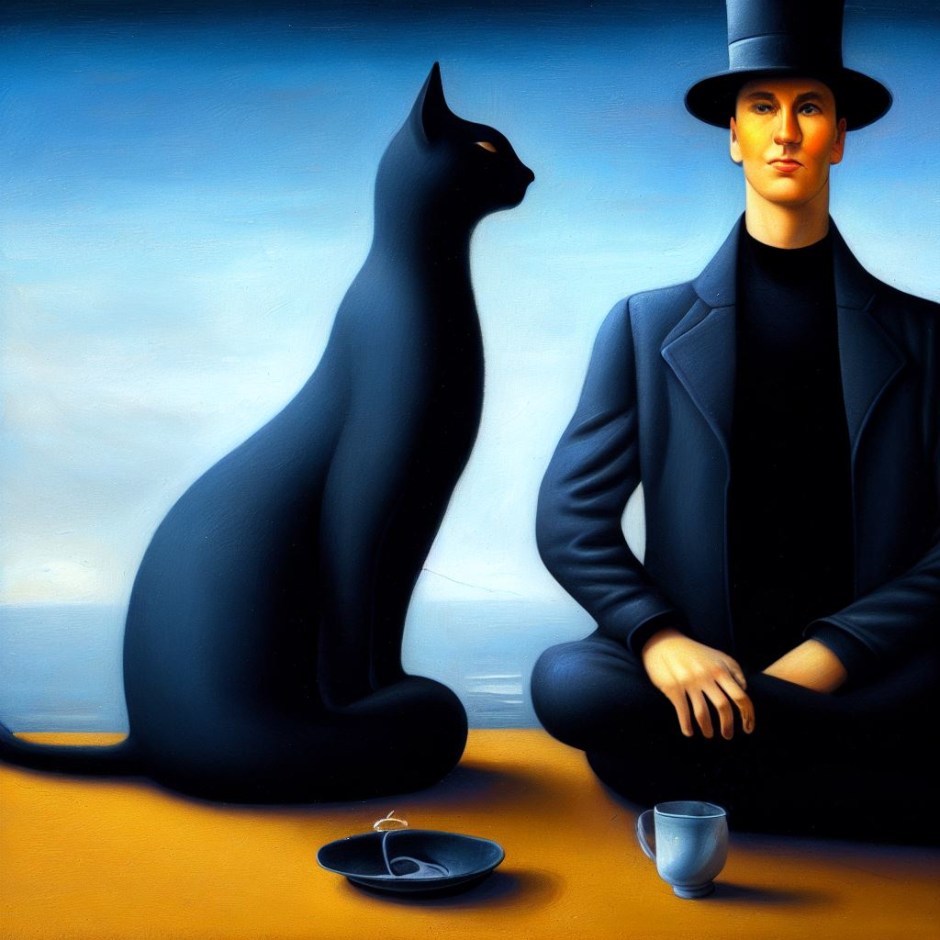
A man standing in the middle of a river - an oil painting in the style of René Magritte
Created using AI Bing Image Creator

Rhymester, read thyself

“You have lost your wits and have gone astray; and, like an unskilled doctor, fallen ill, you lose heart and cannot discover by which remedies to cure your own disease.”
Aeschylus, Prometheus Bound

With mobile phones, we have become accustomed to immediate responses,
so no one wants to wait for anything anymore. Add to that the quality
of our relationships—likely comparable to the nutritional value
of a plastic bowl of instant noodles—and it’s no wonder we are trapped
between the Scylla of solitude and the Charybdis of addiction to dating apps,
ending up lonely one way or another.

Dealing with people sooner or later brings disappointment. I get that.
But we all have our quirks and neglected issues, so maybe it’s time
to stop being harder on others than on yourself.
Give them a chance, and they may pleasantly surprise you,
said the one least likely to read his own words.

It’s all about appearance

Sometimes I have the same dream over and over again,
as if a turntable needle were stuck in the groove of a broken record
that would otherwise be an uneventful night. It wakes me up eventually,
and more often than not, I cannot get back to sleep.

Since tossing and turning makes no more sense than getting out of bed,
I choose the latter, and, trying to avoid the usual squeaky floor concerto,
I walk over to my desk.

To prevent the neighbours’ wrath, I’d rather not touch the typewriter
and settle for my good old friend, the fountain pen—or I would
in the pre-digital era, but sitting in front of a computer screen
doesn’t sound as romantic.

You see, it is all about keeping up the appearance of an artistic vibe.
After all, we are all occasional imposters.

Generations

Like father, like son, or so they say.
But what if the son has his father’s face
but not his voice anymore? Or a mother
and a daughter, like those I saw once
on the bus while coming back from work.

I was dozing off a bit, but I could still hear
a true Aberdonian teen frantically talking
about some fist-involving drama at school.
But at some point, a mature female voice
with a strong Nigerian accent responded.

Intrigued, I opened my eyes and saw them—
like two peas in a pod, yet different.