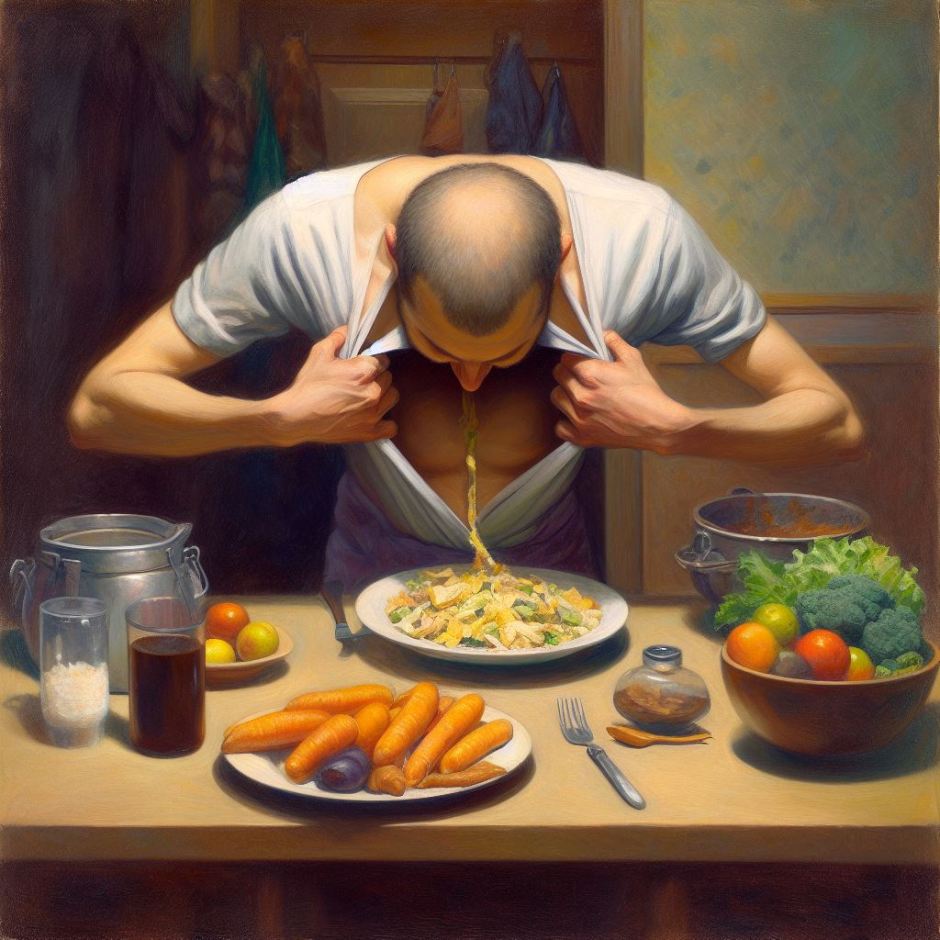
Journal (A bowl of petunias)

Waking up in the middle of the night with a pain in my chest always reminds me of my mortality. It’s not like I think about death all the time, but touching on the subject with such an emphatic reminder is inevitable. At least I’m not superstitious like my father was, who, when asked about making a will in the face of cancer, became really upset, treating the suggestion as a wish for his death. But maybe I just had more time to get used to my condition. After all, I was born with it.

Perhaps it’s a lack of imagination on my part, but the idea of dying has never terrified me. And not because of my Catholic upbringing, with the morbid theatrics of Ash Wednesday and the promise of the resurrection of the dead that I never consciously believed in, not since I left the innocence of childhood. I simply find existence itself rather mundane and prefer to think of myself more as a bowl of petunias than a sperm whale, if I were to refer to Douglas Adams’s iconic The Hitchhiker’s Guide to the Galaxy.
Journal (Peacocks)

I remember the times in Poland, back in the 1990s, when mobile phones slowly began to become popular. There was a joke back then that every businessman coming to a meeting would take out three phones from his briefcase and place them on the table in front of him: one from the Era network because it had better coverage, one from the Plus network because it had cheaper calls, and a very old one from the pioneering Centertel network, the size of a brick, to make it clear that he could always afford it.

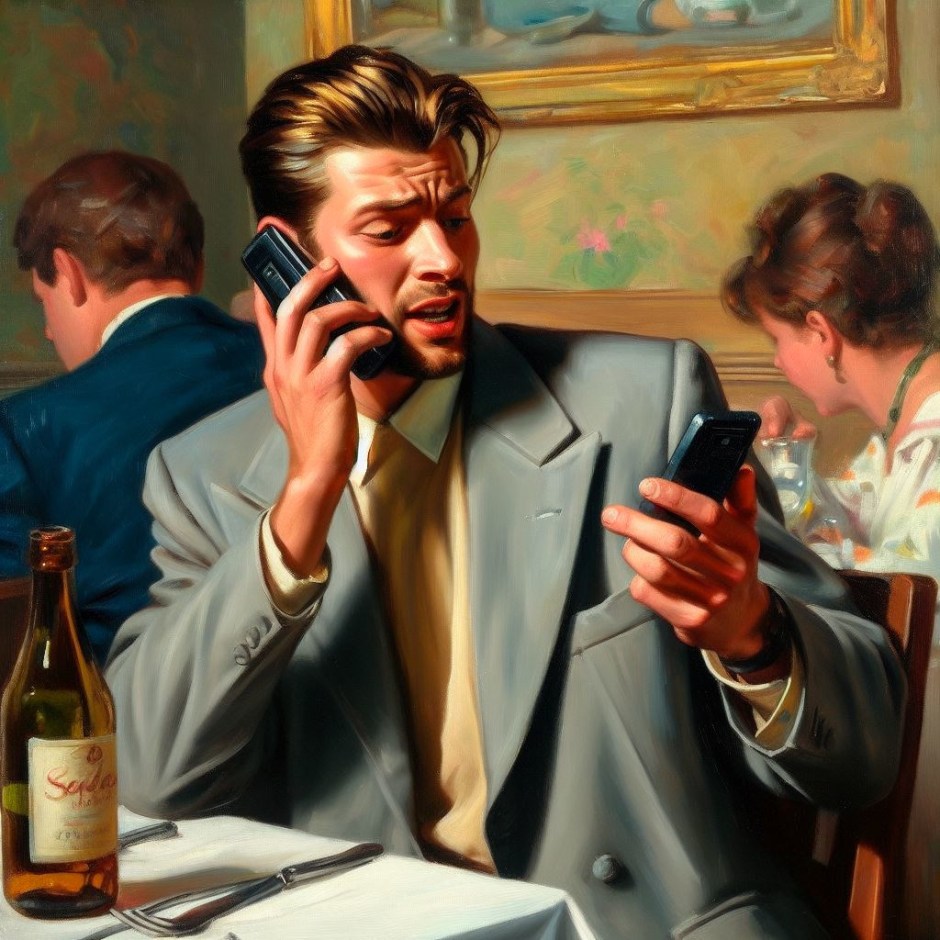
I also remember a friend telling me about an incident that she allegedly witnessed, although I suspect it was also just an anecdote, where in a restaurant, a young man took out his mobile and, in a nonchalant pose, started talking very loudly to it as if he were in a call with someone, when suddenly his phone rang. The flustered man quickly left the restaurant.

To understand the humour of the latter, it’s important to remember that at that time, the rules of etiquette when it came to mobile phones, which were still a novelty, were completely different. On the other hand, this gadget was something that some—men, of course—tried to impress with. Back then, a phrase that describes them became common: skóra, fura i komóra (leather jacket, expensive car, and mobile phone). In Polish, it sounds a bit comical because these terms are slang and they rhyme.

What is most important in all this is that we will always find a way to show off, try to impress others, and demonstrate our superiority. By we, in most cases, I mean men. We are like birds in the mating season—peacocks trying to get a partner and mark their territory. And even if sometimes it is merely comical, it ultimately brings with it many problems. The question is: how can we change this testosterone-laden male culture?

Journal (Am I old?)

Am I old? No. World War II veterans are old. Alan Greenspan is old. Clinton Eastwood Jr. is old. Even Neil Young is old. But me? No, not at all. And yet, I felt a strange twinge when I started reading the fifth edition of Software Engineering by Roger S. Pressman today. It begins with a reminder of the Y2K bug, and I realised that not only was I writing articles about the panicky preparations to prevent the end of the world at the time when it all happened, but that there is a whole generation of adults who can’t remember that atmosphere of impending doom because they were simply not even born yet. So perhaps I’m not quite there yet, but maybe it’s time to face the fact that old age is fast approaching.

Journal (Anorexia of the heart)

Regardless of whether my life is like my cooking or vice versa, I know one thing for certain: I have always been able to fill my stomach full, even if it sometimes results in indigestion. And yet, I’m still hungry. But this type of hunger can only be satisfied by another person. Although, after three years of fasting, I’m starting to see that I can live with this particular anorexia—anorexia of the heart.

Journal (To be young and beautiful)

Immortality is just the cherry on top of the cake, because in order to achieve the desired state of happiness, people not only want to live forever but also be young and beautiful, which is what the entire fashion and cosmetics industries, allied with the pharmaceutical industry, prey on.

I can understand that people during the Renaissance put on thick layers of make-up and wore wigs to hide the effects of syphilis, but when I see modern women, especially very young, even teenagers, powdered so much that it is difficult to tell what their facial features are because they look as if they were covered with plaster like a building façade, then I have a reflex of disgust. The same is true with perfumes. In the times when hygiene was a problematic matter, perfumes probably made sense, but now using a lift with someone drenched in Chanel No. 5 or whatever it is they used borders on torture, especially for a person like myself, endowed with a sensitive sense of smell. And these are only aesthetic impressions, although I doubt that make-up is really neutral for skin. But what about things that actually hurt, like shoes on high heels, botulinum toxin injections, or steroids used by bodybuilders?

When I watched Mothering Sunday with Odessa Young some time ago, the sight of her unshaven legs bathed in sunlight was a picture of absolute beauty (the film takes place in the interwar period, and the director Eva Husson paid attention to realism in detail). I have never been able to understand why women shave their legs, armpits, and pubic hair, especially since I sometimes see undesirable results in the form of rashes. Men don’t do this. And if I were a woman, I would spare myself the argument that they do it for men, because personally, being just an average guy, I like hair, and I’m certainly not alone in this. And if it’s a matter of some stupid fashion, maybe it’s time to change it?

Journal (It’s not me—it’s the world)

Montaigne said that as our birth brought us the birth of all things, so in our death is the death of all things included. But with that in mind, why would I trouble myself with death if it’s not me who died—it’s the world that ceased to exist? And shouldn’t those rather laugh at the end of this spectacle who cried at the beginning, especially if they might have already outlived their purpose?

Here, in the Western world, death has a particularly bad press—if mentioned at all—but you can’t avoid it if you ask about a happy life, since, to follow Ovid in Metamorphoses, we should all look forward to our last day: no one can be called happy till he is dead and buried (from The Essays of Montaigne—Volume 03 by Michel de Montaigne, translated by Charles Cotton). But sometimes, just like everyone else, I ask myself: Was—or is, as I’m still alive—my life a happy one? The problem is, I’m not even sure what that actually means—a happy life. I would say adequate. It’s like the dust on my desk—sometimes I wipe it off, but most of the time I get along.

We value human life exactly because it’s so frail and because it eventually ends—because of death. What would happen to that respect once death was gone?

Journal (A sense of direction)

I just passed the professional certification exam required by my employer. It was my first exam since graduating, so, I won’t lie, I panicked a little because I was already out of practice, and the countdown clock in the corner of the exam application window didn’t help.

To be honest, I don’t like this type of exam where all that counts is the ability to memorise facts. I’ve never been good at this. I remember back in primary school, we had to memorise certain poems and recite them in front of the class for grades, and it was an absolute nightmare—not the recitation part but the memorization.

I learn best by gaining an understanding of the laws governing a given phenomenon, etc. In college, we had a chemical technology course where part of the curriculum was learning diagrams of chemical installations, such as oil refining, the production of nitrogen fertilisers, or certain acids. They were fairly complex, and I noticed students were divided into two groups: those who memorised a bunch of geometric shapes connected by lines, and those who learned the actual process shown in the diagram.

It’s not rocket science to guess who was better off. If someone from the first group was called to the blackboard to draw a diagram and they forgot any of the elements or confused the lines connecting them, they had no way to fix it because they had no idea what they were drawing. In contrast, if someone from the second group made a mistake while drawing, it all came down to following the process, and it quickly turned out that, for example, there was a pump missing between the tank and the furnace that heats the crude oil before it was fed to the distillation column.

And I guess it’s the same with life, where memorising the map is pointless if you don’t have a sense of direction.

Journal (When’s the day)

Ever since I first spotted it on a billboard, I’ve always wondered if life truly was a fatal sexually transmitted disease. But cheer up. Nothing like A Bit of Fry and Laurie in “when’s the day”—I mean, Wednesday—evening, to be precise—after, started with the obligatory good morning, all day of hordeing at work to earn your fiver for a pint of bread—I mean a loaf of lager—I mean … You know what I mean. Well, except for the fact that your own bathroom light switch was just trying to electrocute you. But that would finally solve the dilemma, wouldn’t it, or at least dump it on some other poor bastard’s head? There is an endless supply of us, I can promise you that. So, cheers, my friend.

Journal (On your own)

There is only so much you can do on your own. You see clouds as white until someone puts a pure white shroud in front of your eyes, and only then do you realise how blind you have been all this time. So you decide to follow them, to learn from the master about the sky in fire and the earth in the grip of ice, only to learn that all you can get is discomfort sold as fear—everything else you have to do on your own.