Not quite family

After spending the greater part of my adult life in Scotland, I’m starting to wonder who I really am, because—technically a Pole—not only am I not visiting the old country, but I have even stopped using my mother tongue, since there aren’t very many opportunities for it, and English has now become not only my spoken and written language, but I even think in it. To be frank, I no longer know or care what happens in Poland, and if it were not for the passport I have to renew every ten years, I doubt I would pay more attention to the place than I do to the Solomon Islands. However, I can’t really call myself Scottish, or British for that matter, as I have never really applied for citizenship, mainly because I would have to swear allegiance to the current monarch and his heirs and successors, a thought that burns my republican soul like hellfire. So, I live my little life as an emigrant—a state of mind akin to that of a poor distant relative living in a spare room—if I may allow myself such an analogy—a household member, but not quite family.


More words to ponder at maciejmodzelewski.com

An emigrant must be a fool

I left my country to spare my kids the national hysteria of the Messiah of Nations,
but in the end, they are even more confused than if they were raised there.
Perhaps that’s exactly what was to be expected. After all, even I’m no longer sure
who I am since two decades have severed all ties except one: my passport.
However, my new home doesn’t exactly make it easy to find a new identity.
If anything, I would call myself a Scot rather than a Brit, but that hardly matters,
given that I refuse to swear an oath to the king. So, I settled for an emigrant,
with all the obligations but without the most fundamental right—the right to vote.
This is the price I pay for staying true to my principles, although some might say
I’m just a stubborn fool.

Journal (Peacocks)

I remember the times in Poland, back in the 1990s, when mobile phones slowly began to become popular. There was a joke back then that every businessman coming to a meeting would take out three phones from his briefcase and place them on the table in front of him: one from the Era network because it had better coverage, one from the Plus network because it had cheaper calls, and a very old one from the pioneering Centertel network, the size of a brick, to make it clear that he could always afford it.

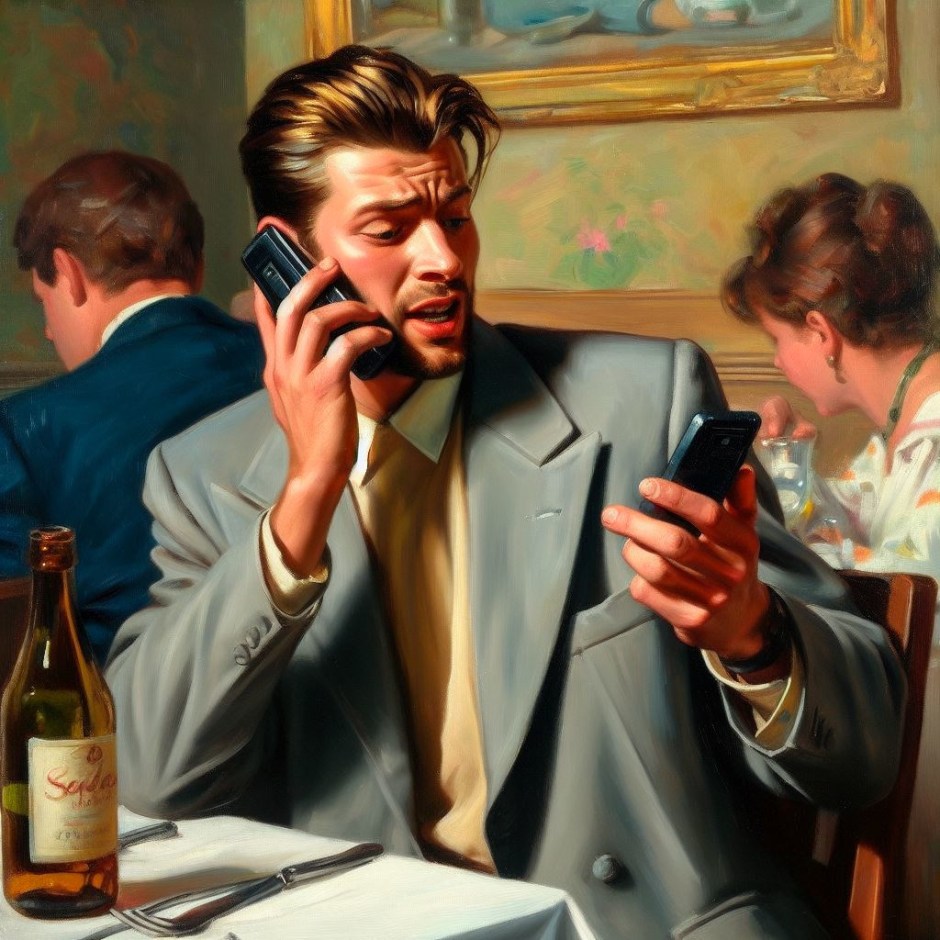
I also remember a friend telling me about an incident that she allegedly witnessed, although I suspect it was also just an anecdote, where in a restaurant, a young man took out his mobile and, in a nonchalant pose, started talking very loudly to it as if he were in a call with someone, when suddenly his phone rang. The flustered man quickly left the restaurant.

To understand the humour of the latter, it’s important to remember that at that time, the rules of etiquette when it came to mobile phones, which were still a novelty, were completely different. On the other hand, this gadget was something that some—men, of course—tried to impress with. Back then, a phrase that describes them became common: skóra, fura i komóra (leather jacket, expensive car, and mobile phone). In Polish, it sounds a bit comical because these terms are slang and they rhyme.

What is most important in all this is that we will always find a way to show off, try to impress others, and demonstrate our superiority. By we, in most cases, I mean men. We are like birds in the mating season—peacocks trying to get a partner and mark their territory. And even if sometimes it is merely comical, it ultimately brings with it many problems. The question is: how can we change this testosterone-laden male culture?

Journal (Tsundoku)

Why do we collect books? For reading, obviously, but sometimes also to compensate for a sense of intellectual inferiority. There is strength in numbers; quantity uplifts, at least until someone pops that balloon by asking how many of them you’ve actually read.

Back in Poland, as a journalist, I was around well-educated people, and although no one ever asked me about it, my HNC equivalent was no match for their masters and PhDs. It may sound silly, but it was a well-hidden thorn in my soul, especially since I could only blame myself—switching between universities, moving from one field of study to another to complete nothing in the end—pure me. Of course, not all of this madness was in vain. Like a true Renaissance man, I could hold a conversation with almost anyone, and this helped me a lot in my journalistic work. But despite this, I couldn’t shake the feeling of inferiority of a provincial boy that I was.

And this is where obsessive collecting came to the rescue. It took me many years, but I had acquired quite a large collection of books, and I was proud to see the admiration on the guests’ faces as they looked around the room that looked more like a library than a living room. It wasn’t like rich people bought entire collections of books just for decorative purposes. I actually read at least some of the books I had. Besides, a large part of my collection consisted of various dictionaries and encyclopaedias—there were no smartphones back then and the Internet was still a novelty—which I used for work and when writing poetry. However, I’d be lying if I denied that this show-up part had no significance.

The most tragic thing about all this was that I had to leave all these books in Poland. It would cost me a fortune to get them to Scotland. But after seventeen years here, I’m slowly building a new collection, although this time I try not to overdo it and, of course, to read them regularly, but the ratio of books read to unread is still not the best. It seems that the Japanese term tsundoku is still closer to the truth than not in my case.

Journal (My life is my story)

As of today, I have decided to stop writing poetry. To tell the truth, I’ve been planning to do this for quite some time now. And no, I am not aping Rimbaud, whose level, by the way, I am not even remotely close to. I simply feel like a fraud with a fig leaf of a quote from Apology, where Socrates said that “not by wisdom do poets write poetry, but by a sort of genius and inspiration; they are like diviners or soothsayers who also say many fine things, but do not understand the meaning of them.” And even if I manage to write something decent from time to time, most of my literary output is mediocre at best. It’s true that I had my moment when I was still writing in Polish and a series of my poems were published in one of the most important literary magazines in Poland, but this is ancient history now.

I stopped writing in Polish, and what’s more, I even stopped reading in my mother tongue. It was not a whim but a conscious decision to motivate myself to dive deeper into the language and culture of my new homeland instead of closing myself in a ghetto like many of my compatriots in emigration. By the way, I still feel a tinge of embarrassment when I remember the sight of satellite dishes mounted on kitchen walls near the wide open windows in the apartments of Polish emigrants to receive Polish TV because mounting satellite dishes on the outer walls of skyscrapers was prohibited for security reasons. If anything, it was the end of a bloody November, and believe me, that’s not fun on the Scottish coast. I can’t even imagine how cold it must have been in those apartments.

So, instead of waiting for another divine inspiration, I decided to start writing a journal, partly because my attempts at writing novels had failed since they were always nothing but a flash in the pan—I’m working on that—and also because of a lack of ideas for interesting stories. A journal definitely sorts the latter problem out—my life is my story. Moreover, the masterpiece of my favourite writer, Witold Gombrowicz, is his diary, which, by the way, I have in the original and in English translation, and I regularly return to both. So why not follow my master’s example, even if my chances of writing anything worth publishing are rather slim?