An ink stain beyond courage

I’m the future stranger you used to love
(remember the declaration? I do).
I’d like to say it’s liberating,
but I still struggle with the time
between closing and opening the curtains.

For a while, I thought I should see
if I was still capable of being surprised,
but now that I’m older, I’m not sure
if I even have the guts to find someone
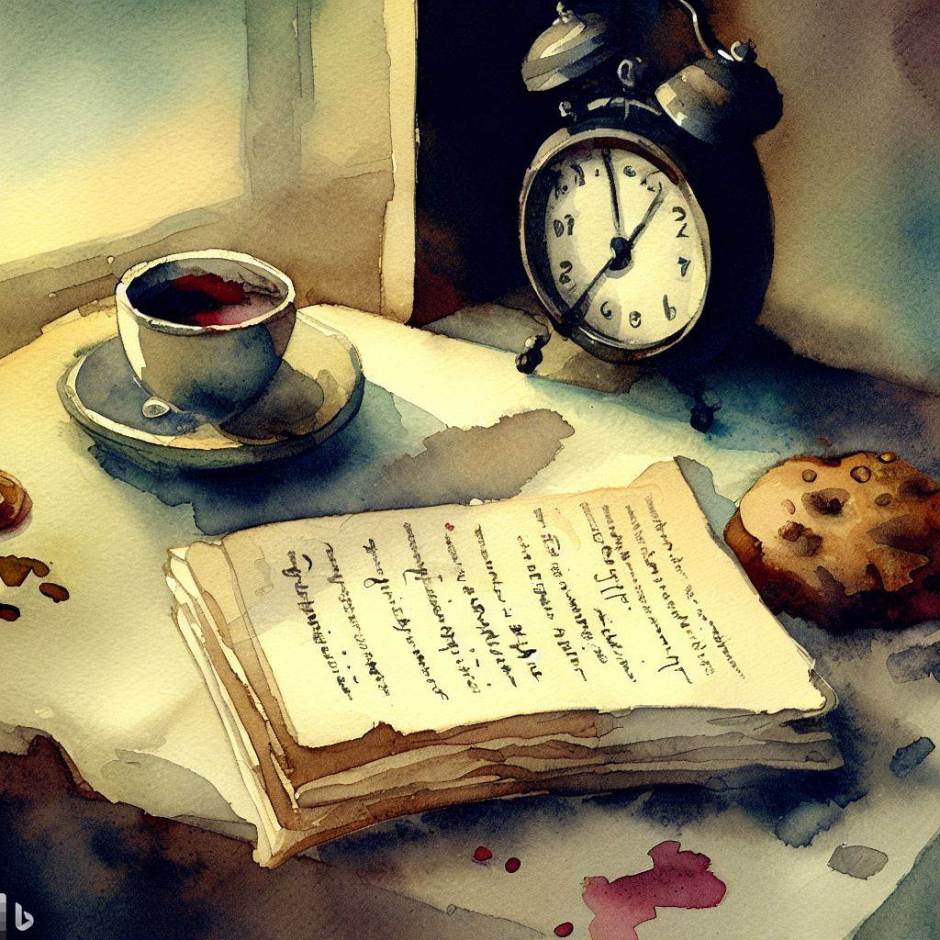
(it sounds so simple in blue ink on papier vélin)

and forget about you.

I still have my fountain pen

Somewhere between a punching bag’s punching bag
and a fully fledged piss-artist, you decided that life is not long enough
to carry on like that, but you also know that it’s nothing
but an act of pure cruelty if you constantly complain about it
and still decide to bring a new one into this wretched realm of yours.
Then you may recall the invisible you barely knew, and only briefly,
as your blooming youth denied him a single breath in your vicinity.
The problem is that he has long disappeared from your sight,
and you have no idea where to start to find him.
I can give you a clue: always look for the one with a book,
mastering the sigla of the Leiden Conventions or chasing the quiet of a meadow
enchanted in the vellum pages of the Voynich manuscript.
Once you find me, never let me go. We may have enough time
for one last vacat page to fill.

A cut-off song

吾が舞へば、麗し女、酔ひにけり(あがまへば、くはしめ、ゑひにけり)
吾が舞へば、照る月、響むなり(あがまへば、てるつき、とよむなり)
結婚に、神、天下りて(よばひに、かみ、あまくだりて)
夜は明け、鵺鳥、鳴く(よはあけ、ぬへどり、なく)
遠神恵賜(とほ、かみ、ゑみ、ため)

Because I had danced, the beautiful lady was enchanted
Because I had danced, the shining moon echoed
Proposing marriage, the god shall descend
The night clears away and the chimera bird (white’s thrush) will sing
The distant god may give us the precious blessing!

Japanese pre-feudal-era wedding song

When, at midnight, he sings with a longing voice,
“A ga maeba, kuwashime yoinikeri,”
the wind pushes him towards his desire.

When, at midnight, he sings with a longing voice,
“A ga maeba, terutsuki toyomunari,”
cherry blossom petals show him the way.

When, at midnight, he sings with a longing voice,
“Yobai ni, kami amakudarite, yo wa ake, nuedori naku,”
a dropped feather caresses his flushed cheek,
and their hands, at the first touch, yearn for more already.

But then the scorching sun of the day comes
and turns the petals into dust on the road,
taking away his voice, so he can no longer sing
“Toh kami, emi tame.”

Survival

Burying a dead bird, we listened to Gil Shaham’s violin in L’inverno.
Then I kissed your ink-stained hands as if nothing had happened,
and we embraced the routine: uneventful nights, quiet mornings,
and tedious climbing up whatever followed, day after day,
with the help of white lies and unsolicited acts of kindness.

Is it possible to die when life is an obligation and love is a calamity?
Can I at least change my mind on the little things once I tell you a story
about my day—an ordinary day, one of those where it’s possible to pass by unnoticed
like an idea of happiness, when it’s easy to regret since life is selfish
and a hug requires a script?

In a way, the word morbid sounds like a promise
that, with some strong language, the light could manage to get through
the shrouds that cover windows, and you no longer have to choose
between Latin and Greek profanities, knowing that survival is nothing
but performance.

In transit

Lately, I have developed a peculiar fascination with symmetry,
like when I read a digital clock and the hour equals the number of minutes
or the time turns into a palindrome. It’s not like I impart any significance
to all those random congruences; I simply find them visually appealing.
But would that imply my divine affinity? Frankly, I find it enough
that I’m already nothing but a non-zero sum of the realised and possible in transit
between pre- and post-individual selves, endlessly rehearsing
the mouthful-ridden opening soliloquy on symptoms mistaken for causes.
There is no need for additional exaltation.

A hand with a handkerchief

It is not about breakfast—or any other meal for that matter—eaten in solitude.
It’s not even about the freezing-cold bed you have to jump into after taking a hot shower.
The problem is in all those little glimpses of unexpected brightness you have no one to share with,
like when you exchange a curious glance with a mellow fox during an evening walk,
or when you make flatbread that smells of exotic spaces you recall your granny used to use,
or when you manage to sneak an ancient Greek profanity into an innocent-looking poem.
Weeping after all this without a hand with a handkerchief—that’s loneliness.

Much ado about the chair

Let’s say I asked you to pick a chair. Without giving it much thought,
you would most likely sit down on one or another, assuming that chairs
are simply things to sit on, wouldn’t you? But this somewhat abstract term
doesn’t say anything about whether it is a sturdy or frail chair, and if the latter,
it would collapse with your very attempt at sitting. And here lies the tragedy
of learning: If you ignored the sage’s máthēma passed in the abyss of his poíēma,
then to avoid any future páthēma, you have to bruise your órrhos, my rhêma.

Tuned to listen

Perhaps Doggerel or Motherese is a way of touching
that special spot in his brain to make him listen.
More often than not, he was mummy’s boy at one point,
so even if only subconsciously, he must remember
that sweet, soft tone and the melodious singsong rhythm
delivering words hard to ignore. Unless, of course, he wasn’t,
and the whole exercise would simply infuriate him
as a deliberate attempt at infantilizing his manhood.
After all, he had spent most of his life grooming himself
to be the next king of the jungle. You can’t turn a lion
back into a puppy. The thing is, he is neither one nor the other,
but just another soul lost and confused in the world of falling,
ill-defined roles.