If the soul were made of Jingdezhen porcelain, would life taste like a sip of yùjiāng when we sang wildly, waiting for the moon, and no longer cared when the tune was done? But you never answered; only your eyes asked: How could I ever forget the narrows of the river?
Tag: life
Journal (Already a ghost)
It’s been three years since I’ve been alone—longer if you consider the period in which my marriage fell apart—and I think I’ve got used to being on my own; I don’t need anybody in my solitary life anymore. At least that’s the mantra I kept telling myself every morning after waking up and every evening before going to bed. But today I met a woman who proved that I’ve been wrong all this time. Well, met is perhaps an overstatement, as she passed me in the grocery aisle as if I were nothing but a mere shadow on the floor, which isn’t much of a surprise considering she looked about half my age and was stunningly beautiful. I must have looked absolutely ridiculous, stopping at the sight of her as if I had turned into a pillar of salt, assuming, of course, that she even noticed me. Even more amazing was that she spoke my native language to the couples she met further down the aisle.
I have no idea who she was, and I’m sure I’ll never see her again. And even if so, what could I offer her? I’m a nobody—a bitter middle-aged man, ridiculously shy and awkward in social situations—who used to write poetry and now just pretends to have something to say in his journal until he gives it up, like everything else in his life. No wonder I’m not afraid of death—I’m already a ghost.
Journal (The itchy scar)
It’s puzzling how easily “I do” becomes past imperfect tense, and despite all the anger, regret, or whatever other feeling prevails, you have to let it go. And you do. Eventually. After all, it is not without reason that they say time heals wounds. But the itchy scar will remain for life. And like the good grammarian you are, you will continue to look for syntactic sugar to alleviate the bitterness of that new cup of tea you have managed to brew, hoping that someone will be tempted to join you at five with a platter of madeleines and one day help you scratch that itch.
Journal (A gracious AI or an obnoxious human)
I’ve never been into games. I find them dreary, but they also require interaction with other people, and that’s a challenging endeavour for me. For most of my life, I stayed on the sidelines, observing others running like lab rats in a maze, which proved convenient when I started working for newspapers. That’s probably why I became a journalist in the first place, as it embraced this habit of mine, allowing me to make a living out of it while at the same time feigning involvement in the affairs of others, at least up to the final punctuation mark, so I could for a little while convince myself that the detachment from the real world that I have always felt is nothing but my imagination. However, one may ask oneself what is more desirable: indifferent reliability or compassionate inadequacy (knowing people, they would aim for compassionate reliability—what a greedy creature human is). But it turns out that if you sugarcoat the former with an impression of sympathy, we are more than happy to embrace it, like the Diplomacy board game players, who were happier to lose to gracious AI than obnoxious human players (see What If the Robots Were Very Nice While They Took Over the World? by Virginia Heffernan in Wired magazine).
Journal (Standing next to the coffin)
Everyone’s going to die. It takes a philosopher or a desperate teenager to say this. Everyone else who should be able to address the topic is likely to ditch it. I’ve never understood why the subject of death is seen as depressing. Of course, there is nothing to celebrate for obvious reasons, but since death is an inevitable part of life, we should at least treat it with equanimity.
I remember when my father died. On the day of his funeral, my grandmother asked me to take a picture of her standing next to the coffin. At the time, I found her request absolutely bizarre. I’ve never been particularly fond of taking pictures in the first place, but such an occasion seemed even less suitable to capture in a photo. And yet here I was, satisfying her request as if we were at a family picnic, having fun. But maybe that was exactly the approach to death I have now. If we photograph birthdays, weddings, holiday trips, and every other event in our lives, then why not funerals? What’s so strange about that? After all, it’s just another life event.
My grandmother lived in a small village, far from any city, and I never perceived her as a philosophising type. The few memories I have of her are related to her work on the farm. Perhaps I should have talked to her more when I still had the chance. Who knows what I would have learned from her? It’s sad that we learn to appreciate people only when they are no longer with us.
Journal (People like us)
It is difficult to see actors as real people, flesh and blood, with their own ordinary lives and problems, because we only see them on the silver screen, in tabloids and gossip columns of glossy magazines. Once they emerge from the shadow of anonymity, with all the glamour of their immaterial lives, we give them the status of demigods. Even their life in the afterlife would have some special dimension, even if it was hell—see Wings of Fame with Peter O’Toole and Colin Firth.
Therefore, it is even more shocking when it turns out that they are subject to the same randomness of fate as each and every one of us. Just like today, when I was watching The Revengers’ Comedies, I saw the familiar face of a young actress who I remember from Four Weddings and a Funeral—Charlotte Coleman. In the latter, she was like a funny, pretty little gem. So intrigued, as I haven’t seen her for a while, especially in any newer production, I decided to check what she was up to nowadays. I was saddened when it turned out that she died in 2001, at the age of only 33, which I didn’t know. Moreover, her life was marked by the tragic death of her boyfriend.
So, it’s worth remembering that despite their peculiar profession, actors are just people—people like us.
Journal (The next Banksy)
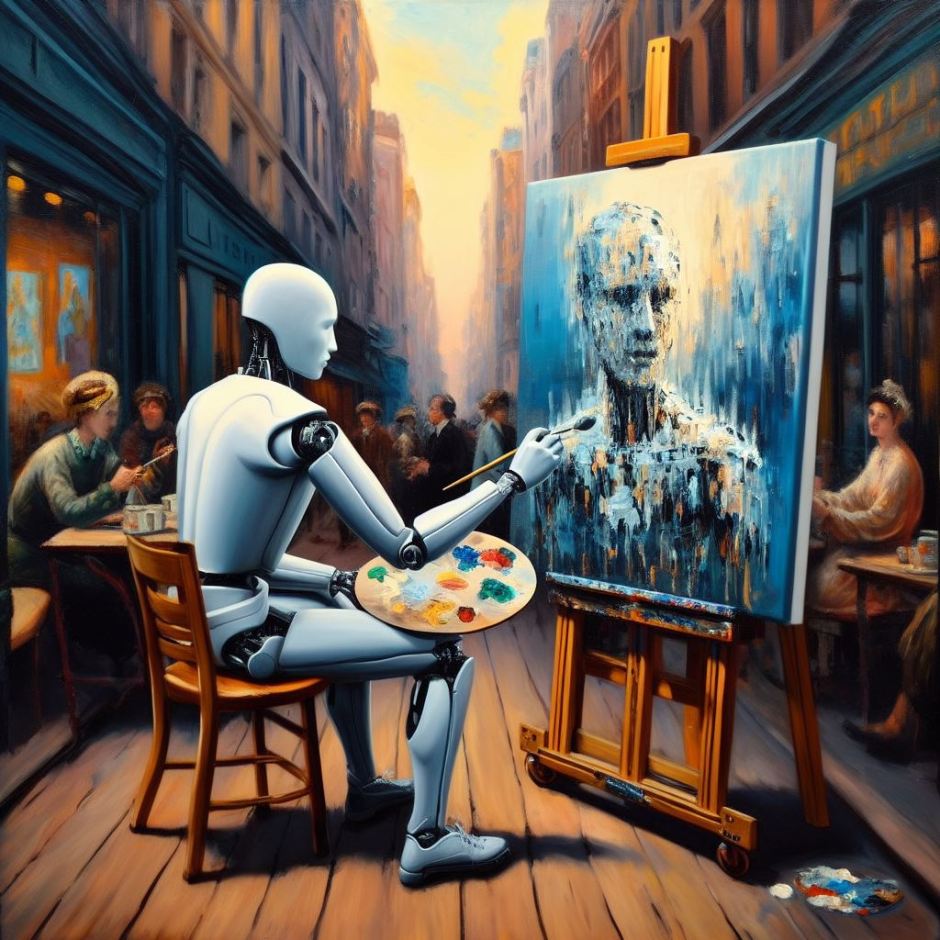
Keeping in mind that AI is barely out of infancy, creations like the one I mentioned yesterday show its real potential and also confirm what I once said about the elimination of art from the pool of viable professions. There is no way any artist outside the realm of greatness, let alone aspiring ones, could survive competing for their share of the art market with algorithms that are capable of creating a piece of art as good, if not better, in a matter of seconds on demand. This is simply a question of when, not if, and I don’t mean a timeline spanning centuries, not even decades. I wouldn’t be surprised if we see auction houses offering AI-created paintings for sale before the end of this decade, although their authorship may initially be hidden under pseudonyms. Who knows, maybe the next Banksy will turn out to be an AI in disguise.
But this vision of doom does not necessarily mean the end of human creativity; it simply shifts the emphasis to the non-professional, private sphere. We will continue to paint, write, make music, or express ourselves in any other creative way, just not for sale but for our own eternal pleasure. Because if we stop doing that, the alternative is not particularly encouraging. In the not-so-distant future, we could face a progressing infantilization of our lives—the reality of the starliner Axiom may become our reality here, on Earth. So forget about the Terminator; watch WALL-E instead.
Journal (Anorexia of the heart)
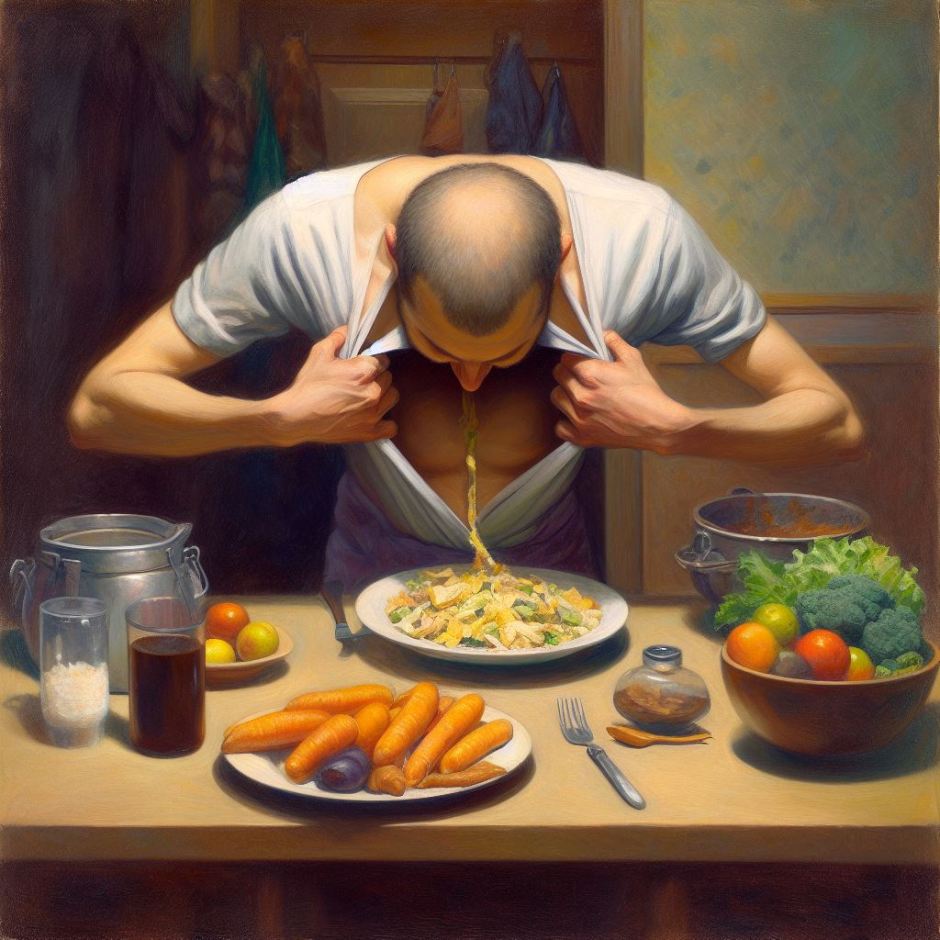
Regardless of whether my life is like my cooking or vice versa, I know one thing for certain: I have always been able to fill my stomach full, even if it sometimes results in indigestion. And yet, I’m still hungry. But this type of hunger can only be satisfied by another person. Although, after three years of fasting, I’m starting to see that I can live with this particular anorexia—anorexia of the heart.
Journal (A sense of direction)
I just passed the professional certification exam required by my employer. It was my first exam since graduating, so, I won’t lie, I panicked a little because I was already out of practice, and the countdown clock in the corner of the exam application window didn’t help.
To be honest, I don’t like this type of exam where all that counts is the ability to memorise facts. I’ve never been good at this. I remember back in primary school, we had to memorise certain poems and recite them in front of the class for grades, and it was an absolute nightmare—not the recitation part but the memorization.
I learn best by gaining an understanding of the laws governing a given phenomenon, etc. In college, we had a chemical technology course where part of the curriculum was learning diagrams of chemical installations, such as oil refining, the production of nitrogen fertilisers, or certain acids. They were fairly complex, and I noticed students were divided into two groups: those who memorised a bunch of geometric shapes connected by lines, and those who learned the actual process shown in the diagram.
It’s not rocket science to guess who was better off. If someone from the first group was called to the blackboard to draw a diagram and they forgot any of the elements or confused the lines connecting them, they had no way to fix it because they had no idea what they were drawing. In contrast, if someone from the second group made a mistake while drawing, it all came down to following the process, and it quickly turned out that, for example, there was a pump missing between the tank and the furnace that heats the crude oil before it was fed to the distillation column.
And I guess it’s the same with life, where memorising the map is pointless if you don’t have a sense of direction.