Journal (People like us)

It is difficult to see actors as real people, flesh and blood, with their own ordinary lives and problems, because we only see them on the silver screen, in tabloids and gossip columns of glossy magazines. Once they emerge from the shadow of anonymity, with all the glamour of their immaterial lives, we give them the status of demigods. Even their life in the afterlife would have some special dimension, even if it was hell—see Wings of Fame with Peter O’Toole and Colin Firth.

Therefore, it is even more shocking when it turns out that they are subject to the same randomness of fate as each and every one of us. Just like today, when I was watching The Revengers’ Comedies, I saw the familiar face of a young actress who I remember from Four Weddings and a Funeral—Charlotte Coleman. In the latter, she was like a funny, pretty little gem. So intrigued, as I haven’t seen her for a while, especially in any newer production, I decided to check what she was up to nowadays. I was saddened when it turned out that she died in 2001, at the age of only 33, which I didn’t know. Moreover, her life was marked by the tragic death of her boyfriend.

So, it’s worth remembering that despite their peculiar profession, actors are just people—people like us.

Journal (Moonlight Sonata)

While watching the film Clara by Akash Sherman today, I heard a fragment of Beethoven’s Moonlight Sonata on the soundtrack, and I felt like listening to the whole piece. Later, in the evening, I chose a random performance, but the first movement was played so flatly and emotionlessly, like a chore, that I quickly turned it off. It was just painful to listen to. Beethoven was probably turning in his grave, speaking figuratively. However, I did not give up and found a recording of Claudio Arrau’s concert from 1970, during which he played this sonata. You could hear the difference immediately. It’s hard to believe that both pianists had the same score in front of their eyes. But this should come as no surprise, given that Arrau is considered one of the greatest pianists of the twentieth century.

Journal (A bowl of petunias)

Waking up in the middle of the night with a pain in my chest always reminds me of my mortality. It’s not like I think about death all the time, but touching on the subject with such an emphatic reminder is inevitable. At least I’m not superstitious like my father was, who, when asked about making a will in the face of cancer, became really upset, treating the suggestion as a wish for his death. But maybe I just had more time to get used to my condition. After all, I was born with it.

Perhaps it’s a lack of imagination on my part, but the idea of dying has never terrified me. And not because of my Catholic upbringing, with the morbid theatrics of Ash Wednesday and the promise of the resurrection of the dead that I never consciously believed in, not since I left the innocence of childhood. I simply find existence itself rather mundane and prefer to think of myself more as a bowl of petunias than a sperm whale, if I were to refer to Douglas Adams’s iconic The Hitchhiker’s Guide to the Galaxy.

Journal (Peacocks)

I remember the times in Poland, back in the 1990s, when mobile phones slowly began to become popular. There was a joke back then that every businessman coming to a meeting would take out three phones from his briefcase and place them on the table in front of him: one from the Era network because it had better coverage, one from the Plus network because it had cheaper calls, and a very old one from the pioneering Centertel network, the size of a brick, to make it clear that he could always afford it.

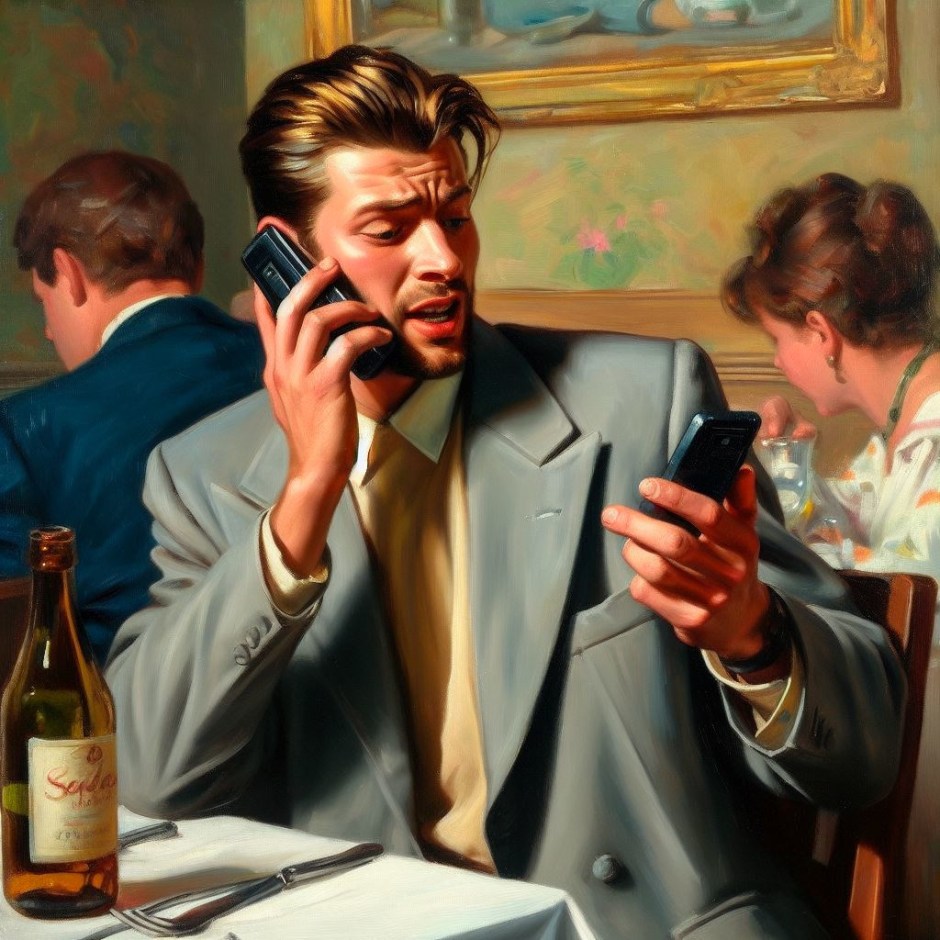
I also remember a friend telling me about an incident that she allegedly witnessed, although I suspect it was also just an anecdote, where in a restaurant, a young man took out his mobile and, in a nonchalant pose, started talking very loudly to it as if he were in a call with someone, when suddenly his phone rang. The flustered man quickly left the restaurant.

To understand the humour of the latter, it’s important to remember that at that time, the rules of etiquette when it came to mobile phones, which were still a novelty, were completely different. On the other hand, this gadget was something that some—men, of course—tried to impress with. Back then, a phrase that describes them became common: skóra, fura i komóra (leather jacket, expensive car, and mobile phone). In Polish, it sounds a bit comical because these terms are slang and they rhyme.

What is most important in all this is that we will always find a way to show off, try to impress others, and demonstrate our superiority. By we, in most cases, I mean men. We are like birds in the mating season—peacocks trying to get a partner and mark their territory. And even if sometimes it is merely comical, it ultimately brings with it many problems. The question is: how can we change this testosterone-laden male culture?

Journal (The next Banksy)

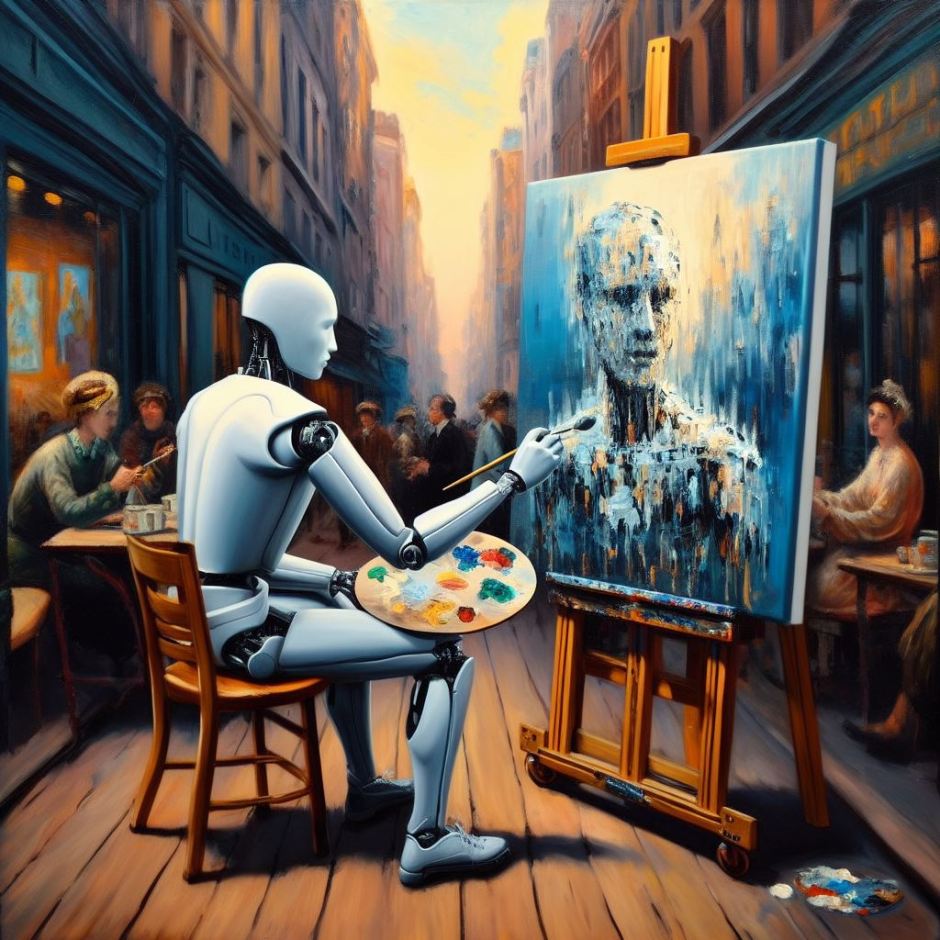
Keeping in mind that AI is barely out of infancy, creations like the one I mentioned yesterday show its real potential and also confirm what I once said about the elimination of art from the pool of viable professions. There is no way any artist outside the realm of greatness, let alone aspiring ones, could survive competing for their share of the art market with algorithms that are capable of creating a piece of art as good, if not better, in a matter of seconds on demand. This is simply a question of when, not if, and I don’t mean a timeline spanning centuries, not even decades. I wouldn’t be surprised if we see auction houses offering AI-created paintings for sale before the end of this decade, although their authorship may initially be hidden under pseudonyms. Who knows, maybe the next Banksy will turn out to be an AI in disguise.

But this vision of doom does not necessarily mean the end of human creativity; it simply shifts the emphasis to the non-professional, private sphere. We will continue to paint, write, make music, or express ourselves in any other creative way, just not for sale but for our own eternal pleasure. Because if we stop doing that, the alternative is not particularly encouraging. In the not-so-distant future, we could face a progressing infantilization of our lives—the reality of the starliner Axiom may become our reality here, on Earth. So forget about the Terminator; watch WALL-E instead.

Journal (A true gift)

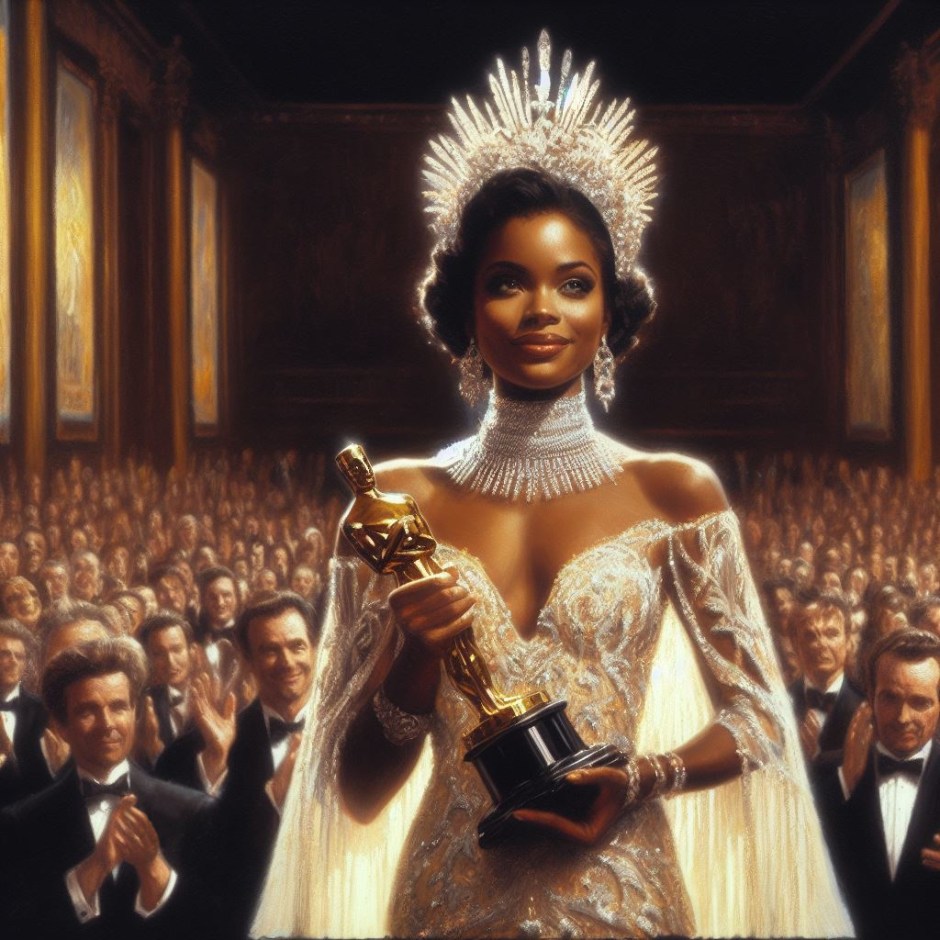
They say a picture is worth a thousand words, and although the overuse of this saying has reduced it to just another cliché, sometimes it still gets to the heart of the matter. As in the case of this image, generated by AI, which I play with from time to time to create illustrations for my texts. It is an expression of pure beauty. And I don’t just mean a beautiful woman painted by an artist. Both the picture he paints and the one of which he is the subject are wonderful compositions on many levels. The colour palette is also delightful. If only I could have it on the wall in my room.

In moments like these, I also regret that I don’t have artistic talent. Being able to create things this beautiful is a true gift. This is probably the only thing that, for me, comes close to religion (I mean faith, not an institution). That and music. I must admit that even though I grew up on the ambrosia of words and I also write myself, words have never made me feel an ecstasy equal to this one.

Journal (Am I old?)

Am I old? No. World War II veterans are old. Alan Greenspan is old. Clinton Eastwood Jr. is old. Even Neil Young is old. But me? No, not at all. And yet, I felt a strange twinge when I started reading the fifth edition of Software Engineering by Roger S. Pressman today. It begins with a reminder of the Y2K bug, and I realised that not only was I writing articles about the panicky preparations to prevent the end of the world at the time when it all happened, but that there is a whole generation of adults who can’t remember that atmosphere of impending doom because they were simply not even born yet. So perhaps I’m not quite there yet, but maybe it’s time to face the fact that old age is fast approaching.

Journal (Anorexia of the heart)

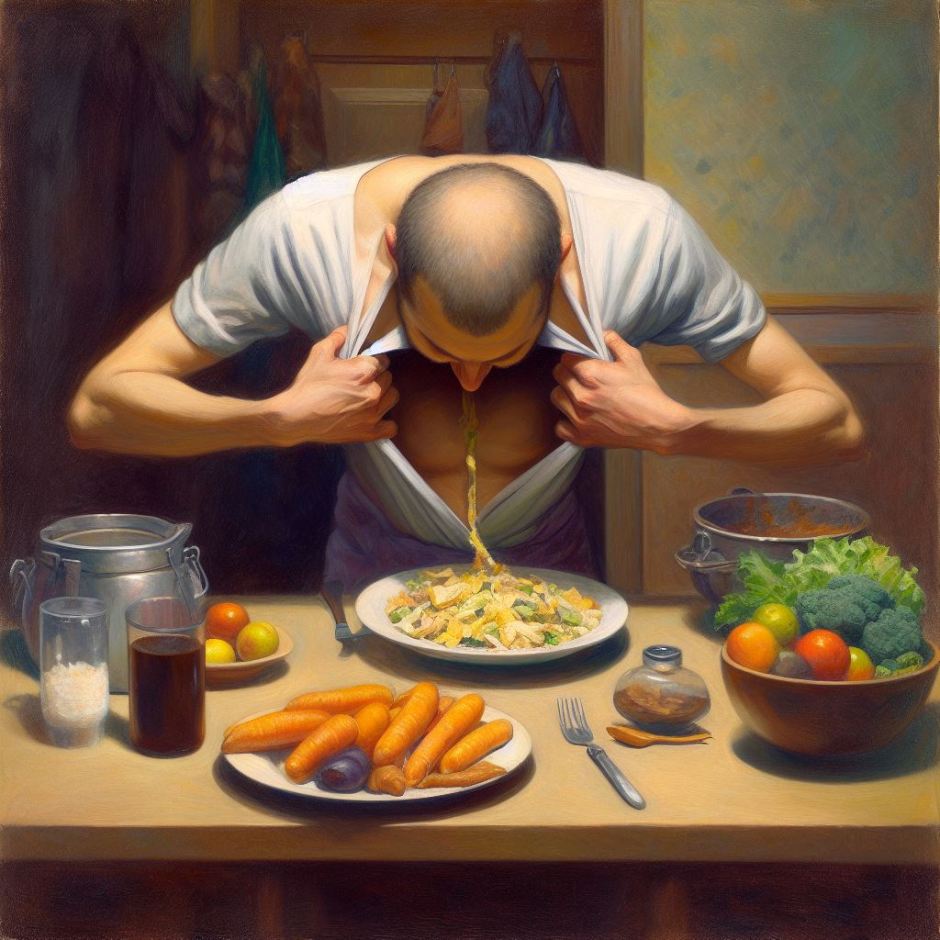
Regardless of whether my life is like my cooking or vice versa, I know one thing for certain: I have always been able to fill my stomach full, even if it sometimes results in indigestion. And yet, I’m still hungry. But this type of hunger can only be satisfied by another person. Although, after three years of fasting, I’m starting to see that I can live with this particular anorexia—anorexia of the heart.

Journal (Matthias of Calluses)

From the very first time, I was curious about all these F-, C-, or N-words I had heard of so many times and what they were all about, but I couldn’t figure them out myself, so I finally asked a friend who was a native English speaker, and only then did he explain them to me. Personally, the first thing that would come to mind when I heard the N-word would be “nerd,” given the way people often perceived me; for the F-word, it was “facetious,” as occasionally I turn to be; and as for the C-word, definitely “calluses,” as in the name of the place my clan’s roots are.

The last one is actually embedded in my surname, which, if translated into English, would be “of Calluses.” So, if I were born in Britain, I would be called Matthias of Calluses. It reminds me of all the stories my father, when he happened to be sober, told me about the legends of our clan. According to him, the founder of the clan was a knight who showed great courage during the Battle of Grunwald, and as a reward for this, King Władysław Jagiełło gave him as much land as he could travel around on his horse from sunrise to sunset. His mother’s clan was supposed to be of even higher rank.

While still in boarding school, I actually talked about that to a history teacher who sometimes came to night duty in our dormitory. He told me that if the entire population of the village has the same surname, the most likely reason is that in the past, their ancestors were serfs belonging to the noble Modzelewski family. When Poland was partitioned, some noble families granted freedom to their serfs, but the only way to do this was through an act of adoption, so overnight the entire village would become a family adopted by the nobleman. This has the hallmarks of probability, although it does not explain the ownership of fields, meadows, and forests.

I don’t know how much truth is in all these stories my father told me or if perhaps the teacher was right, but when I was visiting my grandparents as a kid, I always liked running down the hills that gave the name to our village, then jumping over the stream and running all the way to our forest. It was all so different from my life in the city. I can’t believe I haven’t been there for over thirty years.