Journal (Already a ghost)

It’s been three years since I’ve been alone—longer if you consider the period in which my marriage fell apart—and I think I’ve got used to being on my own; I don’t need anybody in my solitary life anymore. At least that’s the mantra I kept telling myself every morning after waking up and every evening before going to bed. But today I met a woman who proved that I’ve been wrong all this time. Well, met is perhaps an overstatement, as she passed me in the grocery aisle as if I were nothing but a mere shadow on the floor, which isn’t much of a surprise considering she looked about half my age and was stunningly beautiful. I must have looked absolutely ridiculous, stopping at the sight of her as if I had turned into a pillar of salt, assuming, of course, that she even noticed me. Even more amazing was that she spoke my native language to the couples she met further down the aisle.

I have no idea who she was, and I’m sure I’ll never see her again. And even if so, what could I offer her? I’m a nobody—a bitter middle-aged man, ridiculously shy and awkward in social situations—who used to write poetry and now just pretends to have something to say in his journal until he gives it up, like everything else in his life. No wonder I’m not afraid of death—I’m already a ghost.

Journal (A year without war)

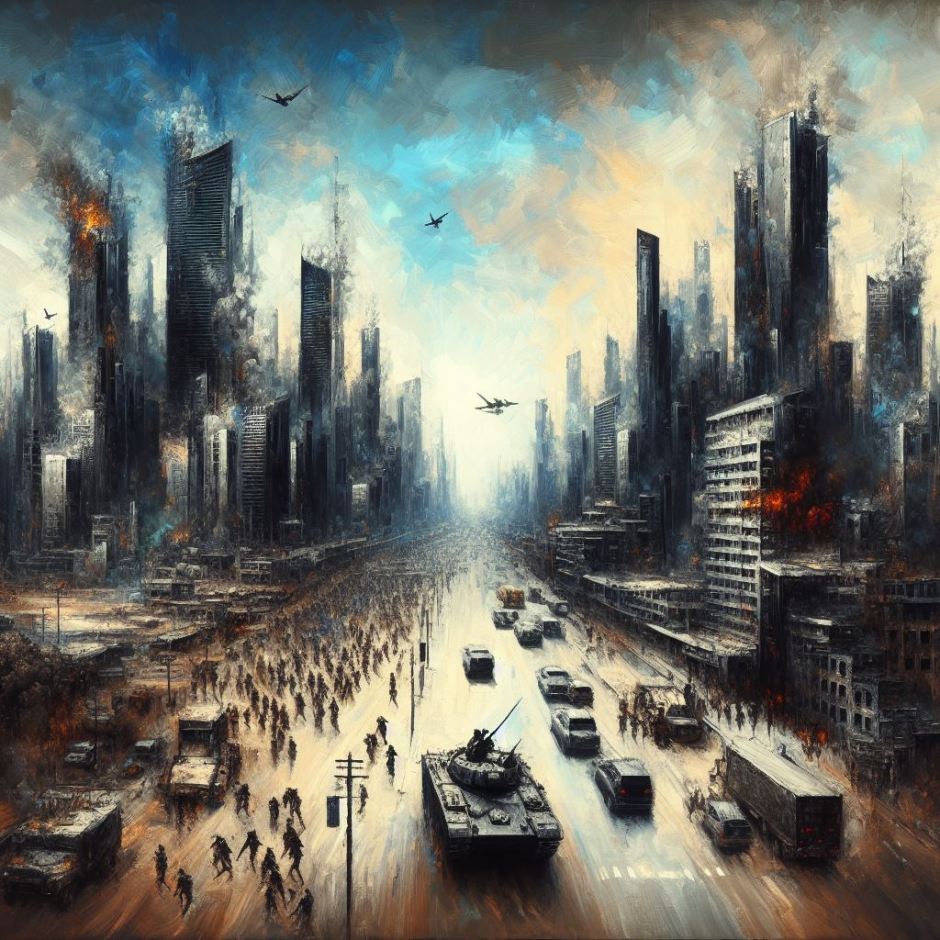
I tried to find out if there has ever been a year without war in human history, but I could not find any reliable source that answered this question conclusively. However, based on various interactive maps, timelines, and articles, I am inclined to say that there were none. With regret, I have to say that we are not a peace-loving species—more like bloodthirsty monsters. And what worries me the most is that, with time, the situation might only get worse as our global population grows, while at the same time resources become depleted and climate change of our own making makes more and more places barely habitable. Add to that all the madmen in power who try to impose their delusional vision of history or morality, and you have a deadly cocktail ready to blow.

Journal (Forever)

How long is forever? Wait, did I just wake up to ask this question, or did the question wake me up? All I know is that every time I open my eyes unexpectedly in the middle of the night, the time stretches on forever, although I’m not sure if this time it actually was about time. Anyway, I remember when I was a little boy, like a member of some primitive tribe whose numeral system was limited to one and many, “now” was the only tangible idea that I could understand. So “forever” was anything other than this instant. But I guess that’s something common for all children. With time, we all overcome this little shortcoming and forever move to a more abstract conceptual realm, unless, of course, we use it in some metaphorical way, as when we complain about having to wait forever for a loved one to call. There are also those who fetishize “forever” with their wet dreams about everlasting life, but they should be careful what they wish for; they just might get it. That would be nothing but the hell of paradise all over again.

Journal (A little gem found in the ashes)

There are films I watch for a single scene only, but to appreciate that scene, you have to see the whole film. Like the one in Marianna Palka’s Motherhood, also known as Egg, where conceptual artist Tina asks Karen, her friend since art school, who is now eight months pregnant and came with her husband to visit her, just as the guests were about to leave her apartment, to send her a picture of Elliot when he is born, thus reviling the gender of the expected child to the father. It may sound unremarkable, but it’s not. That single scene in an otherwise mediocre film is like a little gem found in the ashes, as beautiful as unexpected. And it’s the same in life, with those rare moments we encounter in the currents of everyday mundanity. We tend to forget them quickly, but eventually learn to treasure them and cling to them like a lifebuoy.

It reminds me of the words of George Falconer, the protagonist in A Single Man played masterfully by Colin Firth, who says in the dénouement: “A few times in my life I’ve had moments of absolute clarity, when for a few brief seconds the silence drowns out the noise and I can feel rather than think, and things seem so sharp. And the world seems so fresh, as though it had all just come into existence. I can never make these moments last. I cling to them, but like everything, they fade. I have lived my life on these moments. They pull me back to the present, and I realise that everything is exactly the way it was meant to be.”

And the most important part is that these moments are derivatives of our perception, not expenditures. We don’t have to travel thousands of miles or spend a substantial amount of money. All that is required is a slight shift in optics, perhaps some fine-tuning of the soul. And then even exchanging a glance from a distance with a fox in the middle of the city during an evening stroll takes on a transcendental dimension.

Journal (The doorway to wisdom)

Knowledge of languages is the doorway to wisdom, as Doctor Mirabilis once said, so over the many years of my school education, I learned, or rather, tried to learn, Russian, German, French, Italian, Latin, and ancient Greek. In the end, I only managed to scrape a smidgen of English, and even this was only after I moved to Scotland as an adult. On the other hand, one could repeat after Anne Dreydel that there’s no point in speaking many languages if you have nothing interesting to say in any of them. And for that, you need something more than just repetition of random facts approved by some Ministry of Education official, which, as Michel de Montaigne rightly noted, only stuffs the memory and leaves the conscience and the understanding unfurnished and void.

Since there is no way, for obvious reasons, of joining the bunch following Socrates, the second best I could do was study philosophy at the university, which was my plan if I hadn’t failed my matriculation examination—the maths part, to be precise (my literary essay turned out to be one of the best of the year, so I clearly placed emphasis on the wrong part of my education). I passed it two years later, after leaving the army, but it was too late to pursue the original plan. I had to put on the braces of adulthood and get a job, which was a lesson of a sort. But I never really forgot about it, and from time to time, I tried to study philosophy on my own. The problem was that the books I read either bored me immensely or were too difficult to understand, so at some point, I just gave up.

A few years after coming to Scotland, when I finally managed to achieve a level of English that allowed me to read newspaper articles and technical texts at work with relative ease, I reached for a novel, but it was a total fiasco. And then, by sheer chance, I came across The Tragic Sense of Life by Miguel de Unamuno. It was an e-book, so reading it on one of those fancy e-readers with a built-in dictionary that lets you see the definition of a word if you highlight it turned out to be a delight. Following that one, I started searching for more using the phrase “philosophical essays.” Soon after, I also managed to find a few second-hand bookshops with shelves dedicated to philosophy. With every book I read, my appetite increased.

But then, at one point, I reached a limit. It was soon after I finished reading The Essential Plato, with an introduction by Alain de Botton. I bought Sartre’s Being and Nothingness. I tried to read it. I really did, but it was just too much. I gave up after about eighty pages. The next failure was Kenneth Burke’s A Grammar of Motives, although this time I persevered and made it two-thirds of the way through the book before giving up. So, now I know my limits and that I’m not going to be a philosopher or a philosophy scholar. But I can still enjoy a book of essays by A. C. Grayling, or the aforementioned Alain de Botton, or even Michel de Montaigne, although Charles Cotton’s seventeenth-century English is not easy to read, probably even for a native speaker.


Journal (The itchy scar)

It’s puzzling how easily “I do” becomes past imperfect tense, and despite all the anger, regret, or whatever other feeling prevails, you have to let it go. And you do. Eventually. After all, it is not without reason that they say time heals wounds. But the itchy scar will remain for life. And like the good grammarian you are, you will continue to look for syntactic sugar to alleviate the bitterness of that new cup of tea you have managed to brew, hoping that someone will be tempted to join you at five with a platter of madeleines and one day help you scratch that itch.

Journal (A gracious AI or an obnoxious human)

I’ve never been into games. I find them dreary, but they also require interaction with other people, and that’s a challenging endeavour for me. For most of my life, I stayed on the sidelines, observing others running like lab rats in a maze, which proved convenient when I started working for newspapers. That’s probably why I became a journalist in the first place, as it embraced this habit of mine, allowing me to make a living out of it while at the same time feigning involvement in the affairs of others, at least up to the final punctuation mark, so I could for a little while convince myself that the detachment from the real world that I have always felt is nothing but my imagination. However, one may ask oneself what is more desirable: indifferent reliability or compassionate inadequacy (knowing people, they would aim for compassionate reliability—what a greedy creature human is). But it turns out that if you sugarcoat the former with an impression of sympathy, we are more than happy to embrace it, like the Diplomacy board game players, who were happier to lose to gracious AI than obnoxious human players (see What If the Robots Were Very Nice While They Took Over the World? by Virginia Heffernan in Wired magazine).

Journal (A history lesson in real life)

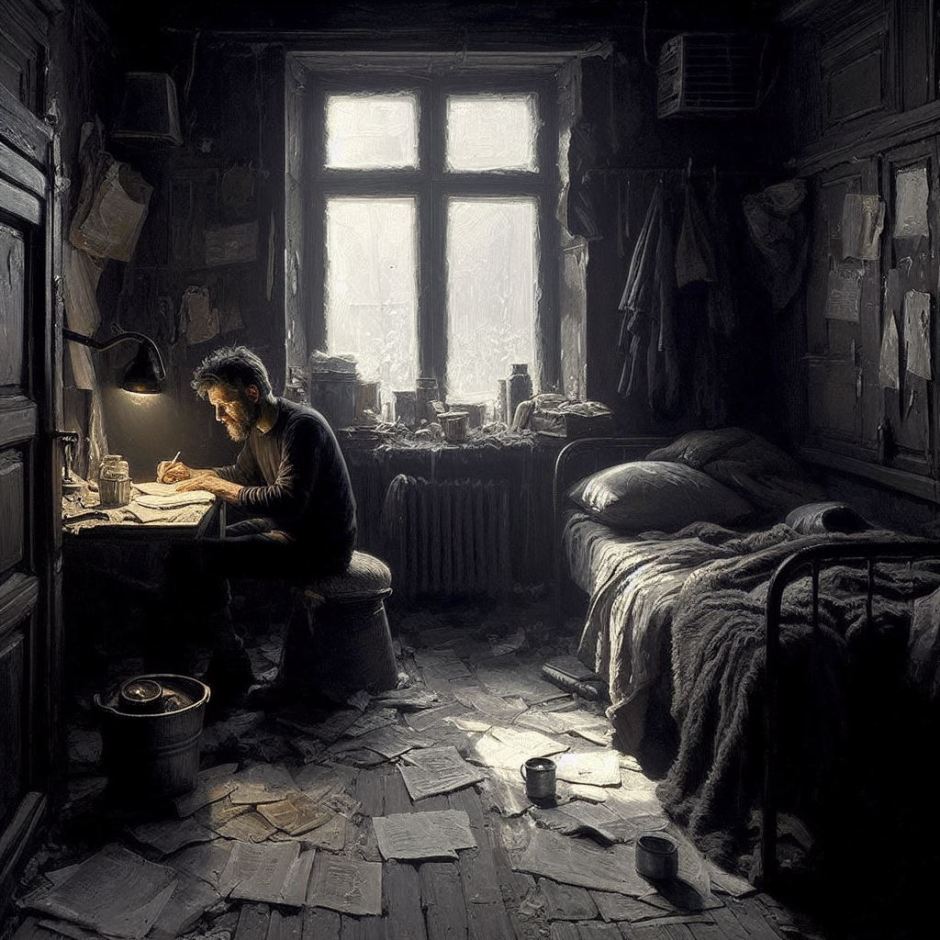
So it started again—the Scottish rainy, windy, cold autumn—and since the walls of the building I live in have no insulation whatsoever, just like last year, I locked myself in the small bedroom, moving there also my desk, as it’s the only room in my flat that is actually possible to heat up to some sensible temperature. The larger bedroom that I normally use as an office, with the radiator turned on full, can barely hold twelve-ish degrees during the winter. So, for the next several months, my bedroom will be my nest—or a prison cell, depending on the perspective we look at this arrangement from.

On a positive note, I can say that it gives me a good insight into the living conditions of the very first inhabitants of this place. Like a history lesson in real life, where the daily ablutions are a particularly interesting experience. But, as they say, what doesn’t kill you makes you stronger. However, one could expect that, after a hundred and twenty years or so, something would change. Insulating the walls of buildings in the cold north seems so obvious. Perhaps having expectations is a mistake on my part.

Journal (Standing next to the coffin)

Everyone’s going to die. It takes a philosopher or a desperate teenager to say this. Everyone else who should be able to address the topic is likely to ditch it. I’ve never understood why the subject of death is seen as depressing. Of course, there is nothing to celebrate for obvious reasons, but since death is an inevitable part of life, we should at least treat it with equanimity.

I remember when my father died. On the day of his funeral, my grandmother asked me to take a picture of her standing next to the coffin. At the time, I found her request absolutely bizarre. I’ve never been particularly fond of taking pictures in the first place, but such an occasion seemed even less suitable to capture in a photo. And yet here I was, satisfying her request as if we were at a family picnic, having fun. But maybe that was exactly the approach to death I have now. If we photograph birthdays, weddings, holiday trips, and every other event in our lives, then why not funerals? What’s so strange about that? After all, it’s just another life event.

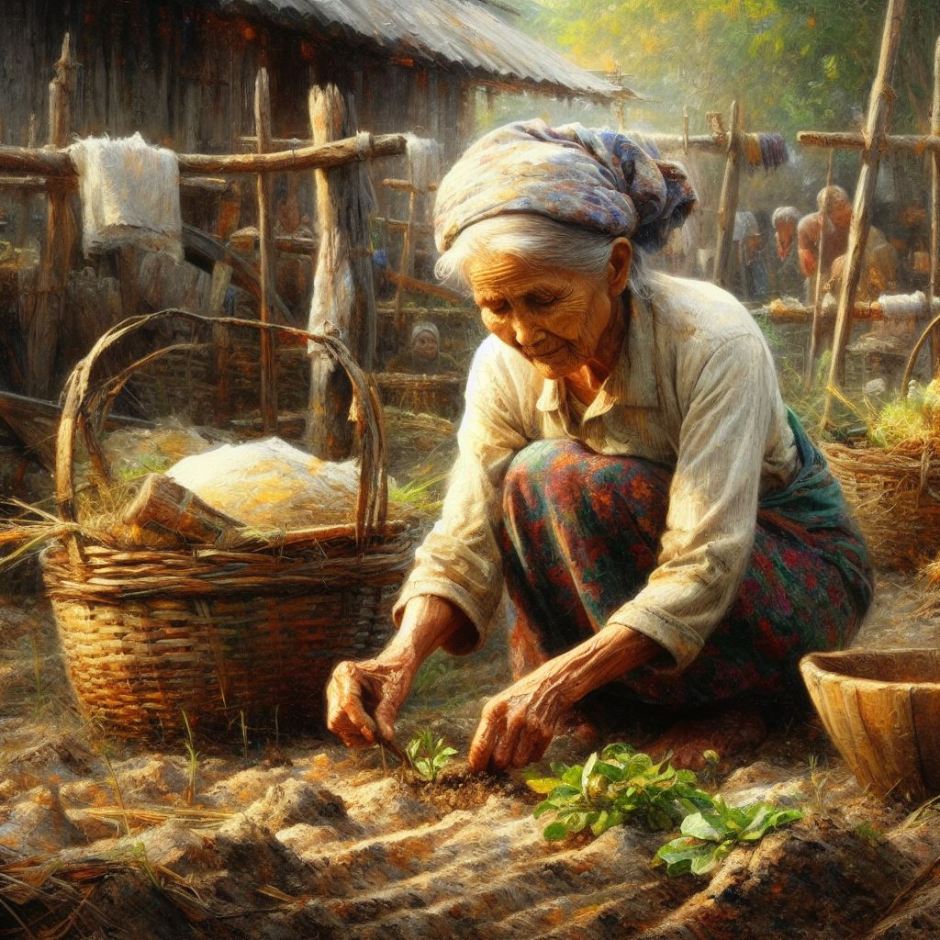
My grandmother lived in a small village, far from any city, and I never perceived her as a philosophising type. The few memories I have of her are related to her work on the farm. Perhaps I should have talked to her more when I still had the chance. Who knows what I would have learned from her? It’s sad that we learn to appreciate people only when they are no longer with us.