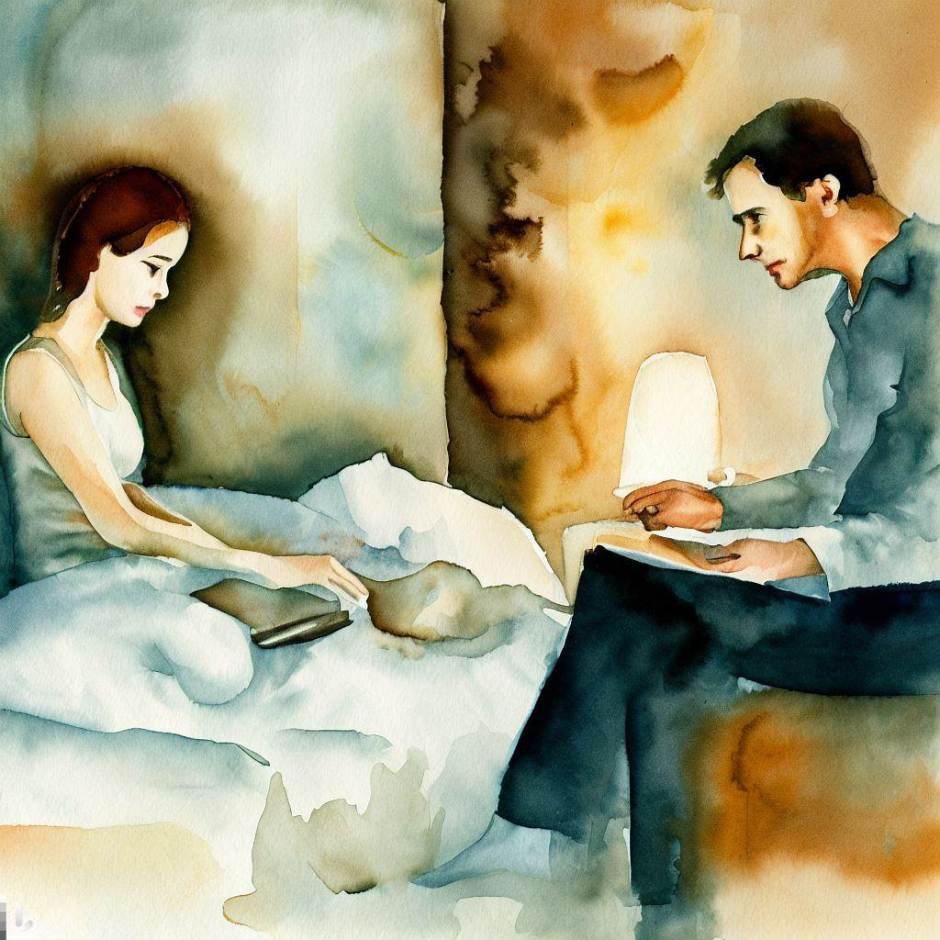
A love letter

I guess I’m no longer looking for anything—
anything in particular, at least
(subject to the occasional surprise).
Perhaps that’s why I have settled on films
with Miss Kendrick—somewhere along the way,
I left behind a pile of first-edition hardbacks,
and my collection of Ikea nutcrackers fell victim
to the financial proceedings—the final stage
of love.


More words to ponder at maciejmodzelewski.com

The final act of love

Wrapped in a blanket,
I pass the morning (it’s noon already?!)
with GLS’s letters and a piece of flatbread
with peanut butter and dried apricots
since peeping at long bygone lives
and inventing odd dishes is the most I can do
while I wait for the final act of misfortune
I brought upon myself when, in a hormonal haze,
I followed tradition and a state-sanctioned
cursed primal urge.

The Decalogue: Take responsibility

How long does it take to live fifty years?
Longer than the blink of an eye, but not as long as you might expect,
sounds about right. Then come all the accretions that stick like a crust
until you can’t tell them apart from your own skin. And when one day
you no longer cry over the shape of your heart, all that’s left is regret
that she threw away your perfectly good wellies, along with the name
you had traded for all the wrong reasons.

Collateral damage

It starts with skipping the shower on the odd occasion.
After a while, showering every other day becomes a habit.
Then you realise that washing the whole body once a week
was actually good enough for your forefathers, but since you
are not religious, you end up settling for doing it fortnightly.
You even come up with quite an elaborate explanation
—something about environmental awareness and the like.
But, I guess, personal hygiene is not the worst casualty
of the lockdown-induced remote work, online shopping,
and heartbreak.

Even a curmudgeon gets nostalgic sometimes

They’ve never had more than a kiss,
and even that would be a stretch.
Besides, I knew where this was going
from the first moment I spotted them
sneaking down Back Wynd.
She wore makeup as if it made her life more tangible.
He was nothing short of perfectly forgettable.
Together, they couldn’t be a better future addition
to the divorce statistics. And yet, despite everything,
at that moment, I wished them a glimmer of a chance.
Perhaps I was being nostalgic and probably a tad jealous.
After all, I’ve been there once, and nothing
has been more tangible since.

Journal (Already a ghost)

It’s been three years since I’ve been alone—longer if you consider the period in which my marriage fell apart—and I think I’ve got used to being on my own; I don’t need anybody in my solitary life anymore. At least that’s the mantra I kept telling myself every morning after waking up and every evening before going to bed. But today I met a woman who proved that I’ve been wrong all this time. Well, met is perhaps an overstatement, as she passed me in the grocery aisle as if I were nothing but a mere shadow on the floor, which isn’t much of a surprise considering she looked about half my age and was stunningly beautiful. I must have looked absolutely ridiculous, stopping at the sight of her as if I had turned into a pillar of salt, assuming, of course, that she even noticed me. Even more amazing was that she spoke my native language to the couples she met further down the aisle.

I have no idea who she was, and I’m sure I’ll never see her again. And even if so, what could I offer her? I’m a nobody—a bitter middle-aged man, ridiculously shy and awkward in social situations—who used to write poetry and now just pretends to have something to say in his journal until he gives it up, like everything else in his life. No wonder I’m not afraid of death—I’m already a ghost.

Journal (Love is blind)

Montaigne said that “in all republics, a good share of the government has ever been referred to chance. Plato, in the civil regimen that he models according to his own fancy, leaves to it the decision of several things of very great importance, and will, amongst other things, that marriages should be appointed by lot;” (Montaigne, 2004).

Let’s think about that last part for a moment. Apart from the fact that these were supposed to be temporary marriages made at festivals to orchestrate eugenic breeding (Brake, 2021), the whole idea is not without some merit. Our Western culture embraces the idea of marriage for love, but keeping in mind that there is a good chance that it ends in divorce or makes couples unhappy over time (DePaulo, 2013), I’m not convinced that it actually works very well. There is a saying in my native language that perfectly fits that hunch: love is blind, and marriage is the best ophthalmologist.

So why not leave the whole affair in the hands of fate for a change? Who knows, maybe we’ll have better luck in this case than with choices made under the influence of the hormonal storm in our brains. Of course, I realise that this is not actually feasible outside of a thought experiment, and I can see many things that could and most likely would go wrong—I’m not that naive—but I also have a feeling that there is a chance for something good in this as well. Besides, we already use dating app algorithms for matching, so is this really that much of a difference?

Because what is the alternative? Suffer in silence with this stranger whom we call our spouse out of habit, or finally come to terms with the idea that marriage is only a temporary matter and establish this state of affairs legally by creating fixed-term marriage contracts, for example, for a decade, with the possibility of extending them for another period if both parties wish so.

References:
Brake, Elizabeth, “Marriage and Domestic Partnership”, The Stanford Encyclopedia of Philosophy (Fall 2021 Edition), Edward N. Zalta (ed.), https://plato.stanford.edu/archives/fall2021/entries/marriage/
DePaulo, Bella, “Marriage and Happiness: 18 Long-Term Studies”, Psychology Today (15 May 2013), https://www.psychologytoday.com/us/blog/living-single/201303/marriage-and-happiness-18-long-term-studies
Montaigne, Michel de, “Essays of Michel de Montaigne—Complete”, Project Gutenberg (2004), W.C. Hazlitt (ed.), C. Cotton (transl.), https://gutenberg.org/files/3600/3600-h/3600-h.htm


The vaginaless monologues (3)

At first, you think she is shy, which is kind of cute, and you two just started dating, so even holding hands counts. Later, you convince yourself that it’s her religious beliefs about virginity, which you respect, or at least try to. Of course, the wedding night is a fictitious event, and everyone is wasted anyway. But then regular life begins, and still nothing happens. Not because of a lack of effort on your part, though. And with every new excuse, your resentment keeps growing until you reach the point where you just can’t do it anymore. You call the fiction what it is and say out loud the unthinkable—divorce. Only then does something crack in the fortress walls, and you finally reach what you have been waiting for all this time. For a while, everything seemed to work out somehow, despite frequent ups and downs. Then the big question pops up, and out of nowhere, your intimate life turns into a precisely scheduled chore. But you don’t complain—it’s still the intimate life after all. Well, in a way, since it makes you feel like a semen injector sometimes. After the little one arrives, you don’t expect anything any time soon, and you both are exhausted after countless sleepless nights with colic and whatever else causes endless crying anyway. But eventually, life settles. Only intimacy is still a minefield. You talk and try to find a way to make it work, sometimes with success, sometimes without. And the resentment starts to build up again, which doesn’t help either. There are days when everything seems great and you dream of a perfect ending in the bedroom. Then the kid goes to bed, and bam, she sparks an argument over some trifle, quick to resolve but enough for her to say she’s not in the mood. Eventually, there is nothing but bitterness and resentment left, and you wonder: What on earth is this love thing all about? But whatever you think, it’s always your fault; you can take that for granted. After all, you are the one who only thinks about sex, aren’t you?