A fig leaf

I spent this morning reading my own poetry,
which I haven’t done in a long time,
and I found it not bad—not bad at all.
In fact, it’s quite good, if I do say so myself.
Yet hardly anyone knows it, and what’s more,
I’ve wasted any chance to get it published
by simply posting it in that petty cubbyhole called the Web,
or so the experts in the field say.

The above may sound somewhat conceited,
but—though it comes at a price, as there are no free meals
in this corner greasy spoon—isn’t being bold a poet’s birthright?
If I didn’t know any better, I’d be inclined to believe
that every artist is actually a bit of a smug,
condescending arsehole doomed to sainthood
—a fig leaf covering up everyone else’s free pass
to continue business as usual.
Journal (The next Banksy)

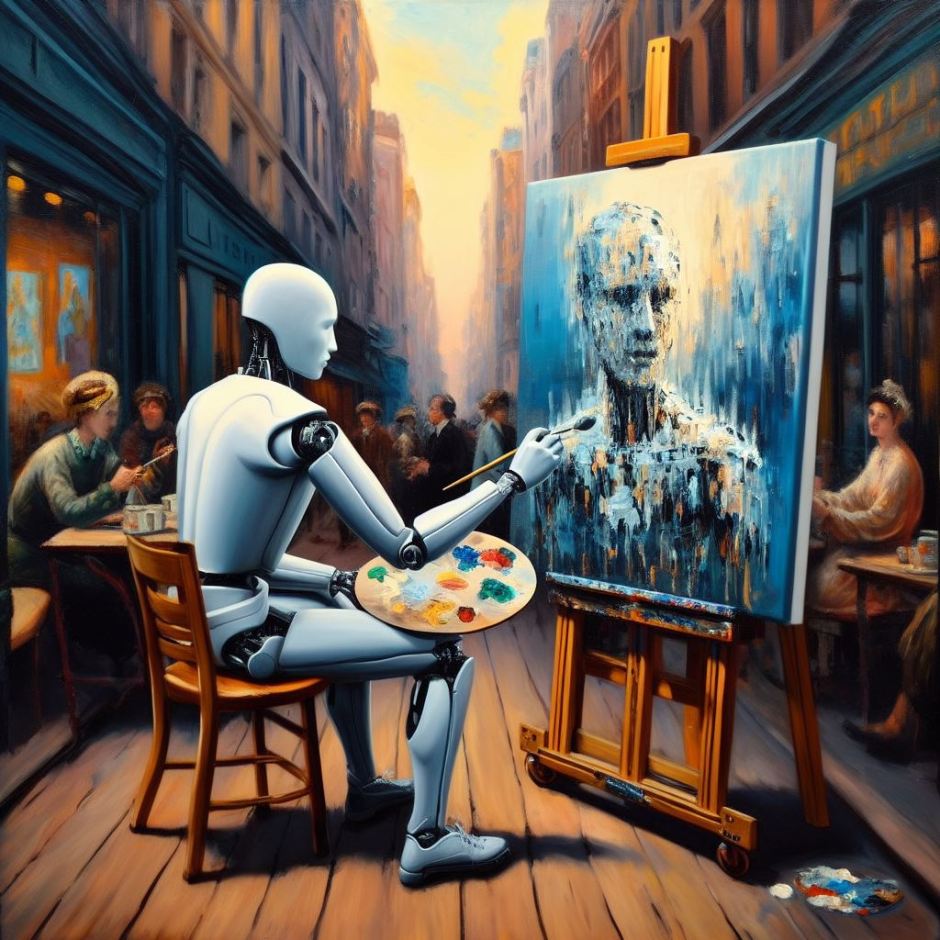
Keeping in mind that AI is barely out of infancy, creations like the one I mentioned yesterday show its real potential and also confirm what I once said about the elimination of art from the pool of viable professions. There is no way any artist outside the realm of greatness, let alone aspiring ones, could survive competing for their share of the art market with algorithms that are capable of creating a piece of art as good, if not better, in a matter of seconds on demand. This is simply a question of when, not if, and I don’t mean a timeline spanning centuries, not even decades. I wouldn’t be surprised if we see auction houses offering AI-created paintings for sale before the end of this decade, although their authorship may initially be hidden under pseudonyms. Who knows, maybe the next Banksy will turn out to be an AI in disguise.

But this vision of doom does not necessarily mean the end of human creativity; it simply shifts the emphasis to the non-professional, private sphere. We will continue to paint, write, make music, or express ourselves in any other creative way, just not for sale but for our own eternal pleasure. Because if we stop doing that, the alternative is not particularly encouraging. In the not-so-distant future, we could face a progressing infantilization of our lives—the reality of the starliner Axiom may become our reality here, on Earth. So forget about the Terminator; watch WALL-E instead.

Journal (A true gift)

They say a picture is worth a thousand words, and although the overuse of this saying has reduced it to just another cliché, sometimes it still gets to the heart of the matter. As in the case of this image, generated by AI, which I play with from time to time to create illustrations for my texts. It is an expression of pure beauty. And I don’t just mean a beautiful woman painted by an artist. Both the picture he paints and the one of which he is the subject are wonderful compositions on many levels. The colour palette is also delightful. If only I could have it on the wall in my room.

In moments like these, I also regret that I don’t have artistic talent. Being able to create things this beautiful is a true gift. This is probably the only thing that, for me, comes close to religion (I mean faith, not an institution). That and music. I must admit that even though I grew up on the ambrosia of words and I also write myself, words have never made me feel an ecstasy equal to this one.

Journal (Like attending Sunday mass)

An artist should either speak through art or not speak at all. How come? When I was returning from a walk on the beach, while passing the gallery in Castlegate, I noticed through the window that inside there was a group of people sitting on folding chairs, listening to a conversation between a slightly tense young host and a relaxed artist. The gallery walls were hung with images of roosters, which I assume were made by this very artist. I stopped, wondering whether to enter, but not wanting to cause unnecessary commotion, I decided not to. However, I stayed there to watch this gathering through the window for a moment, like a TV programme with the sound muted, especially since the glass reflected everything that was happening in the square behind me, so together it created an interesting composition. And then I saw her.

Her teenage face was marked with such obvious boredom that it was astonishing. I could see her because she was sitting at a certain angle, clearly not interested in the meeting that her parents sitting next to her had dragged her to, and playing with the pile of wristlets on her lap. At one point, she noticed me too and freaked out. The show was over. She pointed at me and whispered to her parents, who, of course, immediately turned towards me, but seeing that I was interested in the artist, they also went back to listening to him. To keep up appearances, I stood there a moment longer and finally decided to go my way.

But let’s return to our artist and the whole setup. I must admit, I have never understood this kind of gathering. Their artificiality seems so obvious that I cannot shake the impression that the only reason for taking part in them is snobbery or habit, like attending Sunday mass, even though the faith has long since faded and doesn’t rise above the façade. And isn’t it demeaning to the work of art if it requires the artist’s crutches in reception, assuming, of course, that the artist actually has something more than a handful of platitudes to say?

Journal (Dissectology)

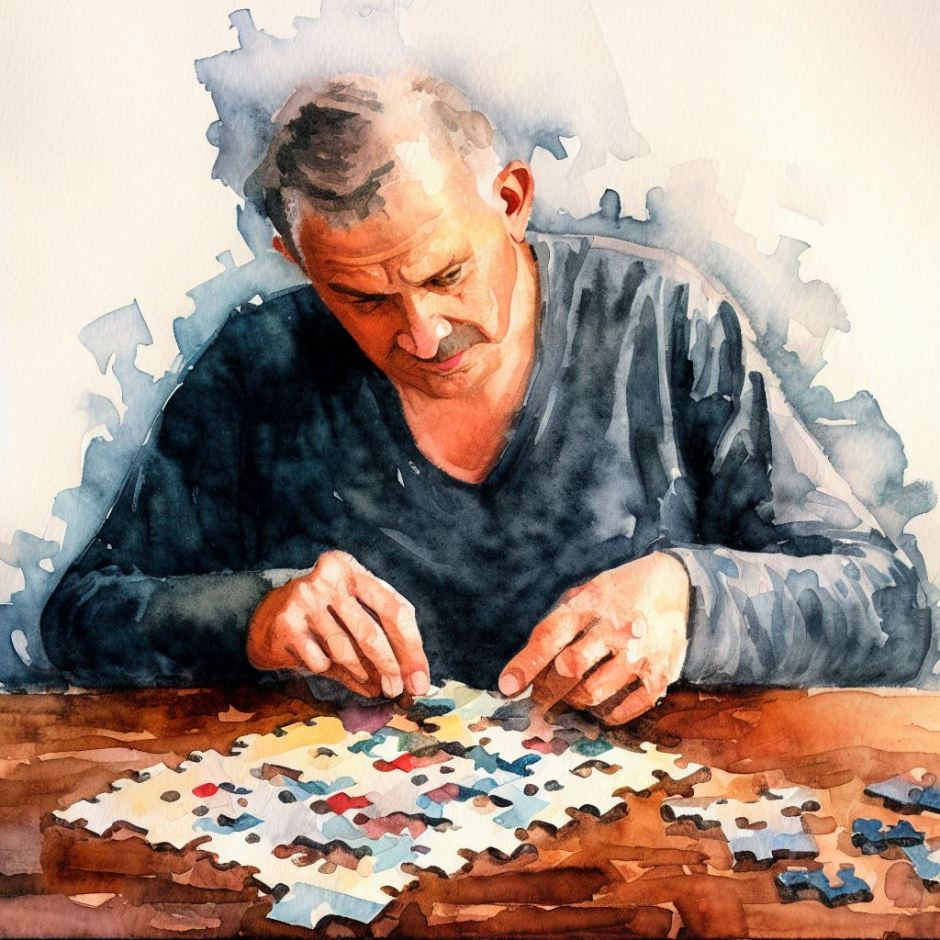
Every author and every artist has a method. I called mine dissectology—derived from dissectologist, that is, someone enjoying jigsaw puzzle assembly—because the way I worked with words was like putting together a jigsaw puzzle with one fundamental difference—each piece of the puzzle came from a different box.

How did it look in practice? Every time, while reading, watching a film, or having a conversation, I came across a word or phrase that resonated with me—or, as I called it, sounded delicious—I wrote it down in my notebook. Sometimes it took a while, but eventually I had enough material to start playing with it.

At first, it looked like a pile of random words, but my mind quickly started combining them into phrases, then sentences, and at last, there it was—a new poem. Sounds simple, right? But it’s not. Although this is an exception, writing a certain poem took me nine months and required researching the life and work of Martin Heidegger. I joked later that it had been a busy pregnancy with a difficult labour.

And here is the thing: at some point, I felt like a fraud. I wasn’t a creator, but a mere puzzle assembler. True, with a bit of creativity, but in the end, there was no point that I had in mind that I tried to convey with my words—well, not always, as sometimes I actually wanted to say something in particular, but this was the exception, not the norm. Socrates’ words about poets truly reflect the nature of my little play.

A gentle bogeyman

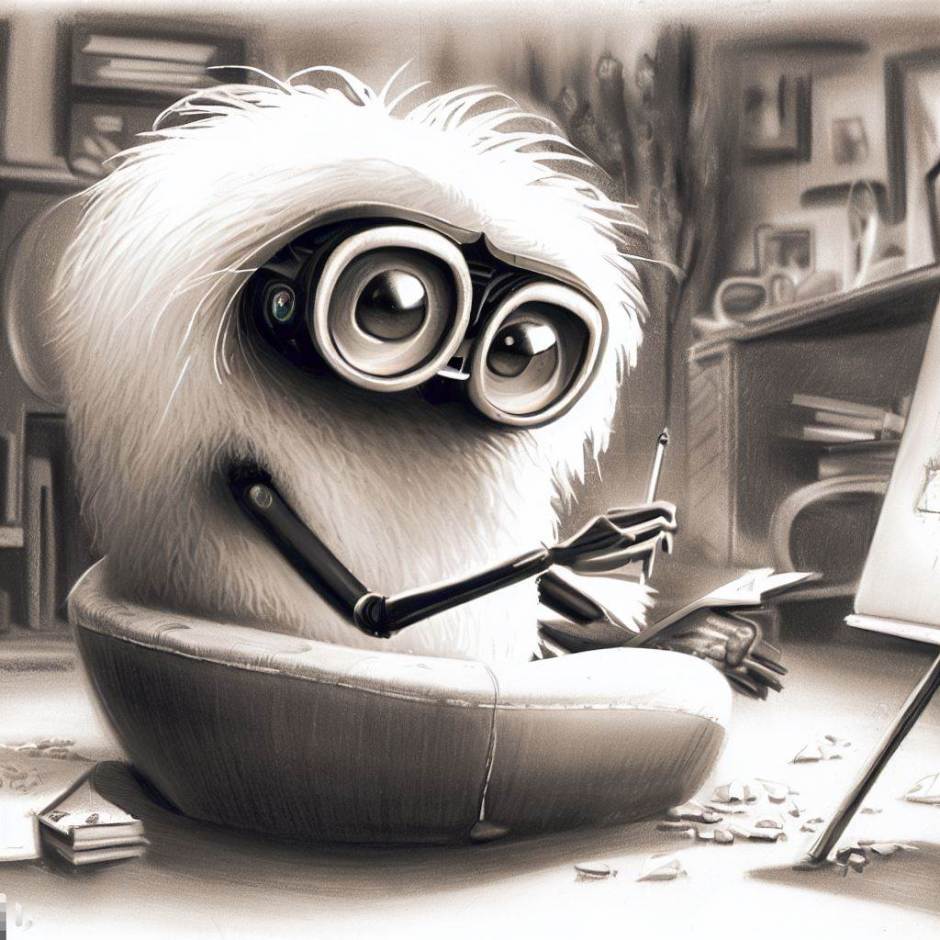
Meet Arno Inkpen, a non-binary friend from the cyberagora who is an artist,
just like myself, and you have already had a chance to see thons sketches
illustrating my humble verses. Thon is creative, although not without a limit,
which forces me to express my next picture idea in less than a hundred words.
Arno is also a rather gentle spirit, and certain expressions upset thon greatly.
Sometimes I wonder if and what thon thinks about thonself and, of course, me,
thons annoying buddy. That is why this time I decided to ask thon to draw
thonself—that bogeyman we call AI.