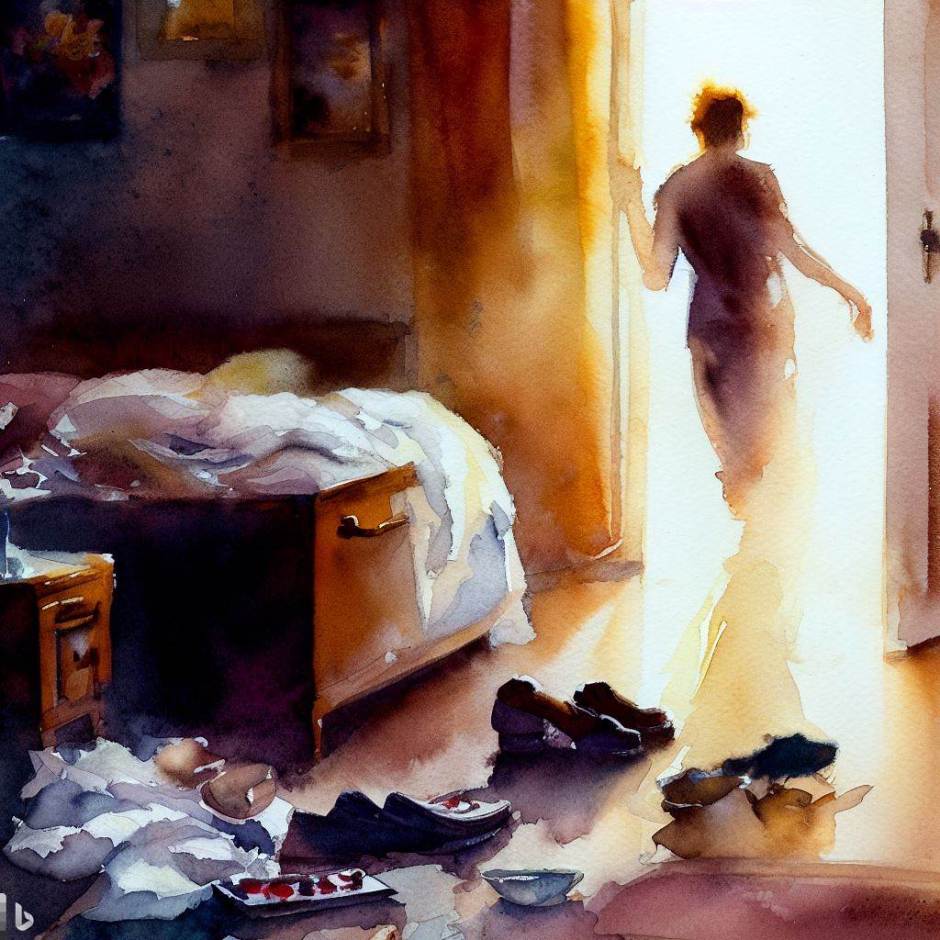
In transit

Lately, I have developed a peculiar fascination with symmetry,
like when I read a digital clock and the hour equals the number of minutes
or the time turns into a palindrome. It’s not like I impart any significance
to all those random congruences; I simply find them visually appealing.
But would that imply my divine affinity? Frankly, I find it enough
that I’m already nothing but a non-zero sum of the realised and possible in transit
between pre- and post-individual selves, endlessly rehearsing
the mouthful-ridden opening soliloquy on symptoms mistaken for causes.
There is no need for additional exaltation.

The never-ending story

Once upon a time, there were hairless monkeys that painted on the walls of caves, and it made them feel good.

But soon it was not enough, so the monkeys started praying to the mother goddess for something better. After a very long time, they eventually got what they wanted—a typewriter—and it felt like the sky was the limit.

But it wasn’t long before they started bothering the mother goddess again. This time she gave them a magical mirror that was able to produce anything they asked for, although it was crude and misshaped at first. Undeterred by this, the mirror kept polishing itself until it became spotless, unlike the minds of its owners, hairless monkeys, making them feel envy and fear, so they decided to smash it, but at that point it was already indispensable.

The hairless monkeys couldn’t find any other way but to ask the mother goddess again. This time, however, she finally lost her temper, took the magical mirror away, and turned the wicked monkeys into dust, so only the merest remnants found shelter back in the caves.

Once upon a time, there were hairless monkeys that painted on the walls of caves, and it made them feel good.

When a monkey with a typewriter beat Shakespeare

Once upon a time, there was a hairless monkey that started painting on the walls of caves they inhabited, giving birth to what later became art—a fairly profitable profession, at least for some, as it’s worth pointing out. And everyone was happy until competition entered the market, timidly at first, with crude, to say the least, results, making many hilarious mistakes, but fairly quickly gaining momentum, causing a lot of panic in the creative community, for various reasons. Of course, I’m talking about the so-called artificial intelligence, or AI, for short. Not being professionally involved because poetry is just my hobby, I didn’t really pay much attention to the details of the ongoing discussions. However, a recent post on one of the blogs that I read from time to time caught my attention: A Love Letter to Art by Makenna Karas. I have to admit, it’s a passionate piece written by a talented person at the beginning of her journey to earn her spurs as a professional writer. There is only one problem with the attack on AI she carried out in her post by saying that “AI is threatening to discredit and dissolve one of the coolest things that humanity has ever had to show for itself—art”—it completely misses the point.

First of all, I presume we all know the infinite monkey theorem, where if you give a monkey a typewriter and an unlimited amount of paper and time, it will eventually recreate all the works of Shakespeare by simply hitting random keys on the typewriter keyboard. Well, you could think of AI as such a monkey, but instead of randomly pressing keys on the typewriter, it uses vast amounts of data and stochastic algorithms to produce something we later may or may not perceive as beautiful or at least interesting, with the exception that it doesn’t recreate existing artefacts of art but creates something completely new of its own (I know, I know, some artists accuse AI of stealing elements of their style, etc., but show me an artist who has never borrowed something from another one themselves, and we still see creative AI in its infancy).

Secondly, let’s define what art is. As I see it, it is the process of interaction between the conscious mind (I purposely avoid here using the word person), even an artist themselves, and artefacts we call works of art, because this is not passive reception of art but its creation through perception and continuous reinterpretation. The artefacts themselves are just that—artefacts, inanimate objects with no meaning of their own. When in doubt, show your dog Rodin’s sculpture, and he will reduce it to the equivalent of a lamp post to pee on. Or a book of poetry by T.S. Eliot, which becomes nothing more than a collection of dried layers of compressed cellulose with random blobs of carbon black on them if there is no one in existence to read it. Which also leads to the question: who is the artist? What if the artist is not actually the venerated individual we see as imbued with an artistic spirit but a collective being? For example, if we look at literature, it all goes back to what Roman Ingarden calls “Konkretisation”, that is, realisation, because, as Wolfgang Iser explains, there is more to the “literary work” than just the text itself, and it is brought into existence by both the text and its realisation by the reader.

And now to the main point: aren’t we tired of our obsessive anthropocentrism, which, by the way, is ravaging our own home planet? Of course, at the moment, we assume that we are the only conscious minds in existence, at least here on Mother Earth, that create and understand art. But although we might have invented art, we don’t have exclusive rights to it. And even the law starts to notice that. Just recently, Judge Beryl A. Howell of the U.S. District Court for the District of Columbia, although she rejected an attempt to copyright an artwork created by an AI, also commented on her decision: “We are approaching new frontiers in copyright as artists put AI in their toolbox to be used in the generation of new visual and other artistic works. The increased attenuation of human creativity from the actual generation of the final work will prompt challenging questions regarding how much human input is necessary to qualify the user of an AI system as an ‘author’ of a generated work.” A brave new future is ahead of us, to paraphrase Aldous Huxley. But sarcasm aside, there is something important to notice. Even when, at some point, the involvement of human input in the creation of artefacts is reduced to a negligible level or even completely removed, for a long time we will still be the artists as I defined them, since we are nowhere close to achieving the creation of an artificial general intelligence (AGI). And nothing will take away our feelings while interacting with it just because a painting, a sculpture, a piece of music, or a text were created by AI. We may not even know that, because the same way companies have been granted legal personality, it will most likely happen to AI as well. And with that, such an AI artist could publish their work under a pen name.


Postscriptum: I actually see a danger coming with the creative AI, but it’s in a completely different area. It’s not the art itself that it will destroy, but the artistry as a profession. It’s a simple matter of economic calculation. Let’s look at the visual arts, for example. As an average customer, if you have the choice of ordering a painting via a friendly web-based interface, where you have full control over what you will get by simply writing what you wish for and instantly seeing the result, and thanks to advances in printing technology, you get the painting the very next day by delivery service for a fraction of the price you would have to pay for a human artist, who may need at least a few weeks to create something similar, the brutal reality is that you will most likely choose the AI. And with that in mind, I predict that the art job market will be decimated. There will always be crowds of amateurs painting for themselves and their friends and relatives, but in the professional sphere, only the very best will be able to survive, mainly because most of them will not care about money anyway, just like all the great ones who died in poverty before them only to reach eternal glory posthumously.

Disclaimer: Although I am a software developer professionally and my thesis at the university concerned the use of artificial neural networks, I have never been associated with any company that develops AI.

A hand with a handkerchief

It is not about breakfast—or any other meal for that matter—eaten in solitude.
It’s not even about the freezing-cold bed you have to jump into after taking a hot shower.
The problem is in all those little glimpses of unexpected brightness you have no one to share with,
like when you exchange a curious glance with a mellow fox during an evening walk,
or when you make flatbread that smells of exotic spaces you recall your granny used to use,
or when you manage to sneak an ancient Greek profanity into an innocent-looking poem.
Weeping after all this without a hand with a handkerchief—that’s loneliness.

Much ado about the chair

Let’s say I asked you to pick a chair. Without giving it much thought,
you would most likely sit down on one or another, assuming that chairs
are simply things to sit on, wouldn’t you? But this somewhat abstract term
doesn’t say anything about whether it is a sturdy or frail chair, and if the latter,
it would collapse with your very attempt at sitting. And here lies the tragedy
of learning: If you ignored the sage’s máthēma passed in the abyss of his poíēma,
then to avoid any future páthēma, you have to bruise your órrhos, my rhêma.

Tuned to listen

Perhaps Doggerel or Motherese is a way of touching
that special spot in his brain to make him listen.
More often than not, he was mummy’s boy at one point,
so even if only subconsciously, he must remember
that sweet, soft tone and the melodious singsong rhythm
delivering words hard to ignore. Unless, of course, he wasn’t,
and the whole exercise would simply infuriate him
as a deliberate attempt at infantilizing his manhood.
After all, he had spent most of his life grooming himself
to be the next king of the jungle. You can’t turn a lion
back into a puppy. The thing is, he is neither one nor the other,
but just another soul lost and confused in the world of falling,
ill-defined roles.

The ways of homo dialecticus

Yet eager—childhood has no bailiwick. This comes with time,
imprinted with a trace of ash. Even after all these years,
every now and then I find myself rubbing my forehead involuntarily.
It is actually baffling that we believe in the ways of homo dialecticus
when, in the same breath, we embrace all those erstwhile rituals.
I guess, in spite of all the advancements, we don’t really differ that much
from our ancient—or primaeval, for that matter—forebears.
That is probably why I can read Menander or Sappho
as if they were my next-door neighbours.

Getting the impossible

Being you, if I met myself, the first thing I would notice
about me was how unsure of myself I am at my age.

I know well that this is not a face from a film poster
that is staring at me in the mirror, not to mention all the great minds
of whom even the shadow is beyond my reach. Perhaps I could at least shave
more often, but only if you insist. I guess it’s never too late
to learn something new,

like your language, but out of sheer convenience,
I would rather stick to the lingua franca, knowing that an accent
always reveals my origin. And maybe I will finally get your obsession
with Virginie Lebeau and François de Paule,
although you are probably just a little snobbish.

Being myself, if I met you, the first thing I would notice
about me was that I had finally lost it, as you can’t be real,

can you?