Journal (Babet is coming)

Storm Babet is coming, and in preparation, I did some shopping so that I wouldn’t have to go outside for the next two or three days. The only thing that worries me a little is the window in my bedroom, which sometimes leaks when it rains and there is a strong wind, but I have long had a towel rolled up on the windowsill so that water can soak into it in case of a leak, and I will have to monitor whether anything is happening.

Of course, a storm like Babet is an exception, but it’s not like Scotland doesn’t have stormy days in autumn and winter. Sometimes the wind blows so hard that it is difficult to walk, especially on the long, straight streets that follow the direction of the wind and are tightly flanked by rows of tall buildings on both sides (I just learned that this kind of street is called an urban canyon or street canyon—every day is a school day). So I’m sure we will be just fine. The only thing is that instead of an evening walk, I will have to limit myself to riding a few miles on the stationary bike in my living room. I haven’t used it for a long time, so it’s worth starting to exercise with it again anyway.


Journal (To be great at something)

Recall that time you thought you would be great—or at least really good—at something. My thing was science—chemistry, to be precise. I dreamt of a great career in some laboratory, imagining myself in a white lab coat amongst the fancy glassware doing experiments, maybe even a bit like in the pictures of mediaeval alchemists (at that time I was still very young and my idea of a scientist was closer to fiction than reality). So I chose an educational path that would enable me to do this. But just as I turned eighteen, somewhere between redox reactions and the Avogadro constant, I realised that I’m going to be mediocre at best. Coincidentally, about that time I discovered poetry, so the fall was softened by the cushion of verse. But now I’m in my late forties, and I know that poetry is not going to fly for me either—I simply switched between chimaeras three decades ago. Who would have thought?

But sarcasm aside, this time there is no cushion to land on, just the bare, hard rock surface of reality. On the other hand, when I think about it, maybe passion is the domain of youth, and I should simply be grateful that I can still move between the table, desk, and bed on my own. At my age, the most important thing might be to learn the principles of energy conservation. I know, I know, I’m approaching fifty—not eighty—but learning is a long, time-consuming process, so it’s probably best to give yourself a little head start. At least this time the mythical character has changed—it’s time to stock up on the obol.

Journal (To sharpen your wits)

I know it’s just grammar, but English sometimes makes me feel uncomfortable due to the constant repetition of words, especially personal pronouns. In my native language, this would be considered a failure of style. But perhaps me being pernickety is just a smokescreen by my shallow mind in denial, and even if every now and then I do happen to have a thought that might be worth sharing, I’m too afraid to do so because every important aspect of life is a subject to controversy, and I’m terrified of conflict. Of course, I could always lean on the crutches of institutional authority, as I did in my journalism days, but this helps only in the professional sphere—personally, I’m a chicken.

Perhaps it’s a matter of my upbringing. I must admit that reading the Epistles, the thirteenth book of The Good Book, in my late forties was something of a revelation, and I deeply regretted not having known its contents in my youth. The problem is also in the fact that the modern education system we are put through is neither in a position to fill the shortcomings of parenthood nor pursue master-disciple-style mentoring. In reality, it’s more like a grinder or lawnmower for shaping an efficient and reliable workforce.

What’s left is self-education. But here lies the problem—you can’t do that alone. As Michel de Montaigne rightly noticed, “conversation with men is of very great use and travel into foreign countries; not to bring back (as most of our young monsieurs do) an account only of how many paces Santa Rotonda—[The Pantheon of Agrippa.]—is in circuit; or of the richness of Signora Livia’s petticoats; or, as some others, how much Nero’s face, in a statue in such an old ruin, is longer and broader than that made for him on some medal; but to be able chiefly to give an account of the humours, manners, customs, and laws of those nations where he has been, and that we may whet and sharpen our wits by rubbing them against those of others.” (from “The Essays of Montaigne—Volume 05” by Michel de Montaigne, translated by Charles Cotton) I especially agree with the idea of travelling to foreign countries because I have first-hand experience with its power and how it changes your perspective and way of thinking. It’s a pity it didn’t happen until I was thirty.

Journal (History as a zero-sum game)

Two seemingly unrelated articles in the Guardian caught my attention this morning. One described the roots of the Israel-Palestine conflict; the other was news about Australia rejecting a proposal to recognise Aboriginal people in the constitution, and I thought about them as I passed the pro-Palestine demonstration in the city centre this afternoon.

First of all, what Hamas is doing is pure evil, another example of a weaponized religion in action, just like in the case of ISIS. But saying that, based on what I read in the first of the aforementioned articles, it seems like Israel, out of its own political calculations, contributed to the growth of Hamas as a way of undermining support for the Palestine Liberation Organisation under the leadership of Yasser Arafat. It’s obviously not the same as what Americans did for the Afghan mujahidin, but it’s hard not to notice some parallels. But what is more important is the way Israel handles the situation in the region and how it treats Palestinians. If Israeli and foreign human rights groups started using the word apartheid, that says a lot. One could imagine that a nation that survived the Holocaust would know better.

And here comes the news about the referendum in Australia. Of course, the situation is different because, even though it has a practical dimension—to improve the living situation of Aboriginal people—the fight is more in the symbolic realm; it’s about Aussies’ honour and acknowledgment of Indigenous Australians in the country’s constitution. There are no border disputes, no living memory of a country that existed prior to the current state of affairs, and no religious fanaticism used as a weapon. And still, the referendum ended in failure, just like the previous one in 1999.

There is a saying that history is written by victors, but the problem with it is that it implies history as a zero-sum game. And even if this is the reality, I would like to think that we are still able to shift that paradigm and finally move to a non-zero-sum game that allows everyone to win.

Journal (No such thing as a free drink)

Falling in love is like a shot on the house in a dubious establishment—free and intoxicating but not without its unpleasant consequences the next morning. The barman is a professional who knows what he is doing, as there is no such thing as a free drink—it’s a trap to make you crave some more, where every next jigger costs you double. At the end, you wake up in a dodgy apartment, laying on the floor in your own spew, or worse—on the street. The irony is that you despise it and promise yourself never again, only to end up in the same bar the very next evening, asking for another round. Lucky few who have never fallen victim to this addiction.

Journal (Already a ghost)

It’s been three years since I’ve been alone—longer if you consider the period in which my marriage fell apart—and I think I’ve got used to being on my own; I don’t need anybody in my solitary life anymore. At least that’s the mantra I kept telling myself every morning after waking up and every evening before going to bed. But today I met a woman who proved that I’ve been wrong all this time. Well, met is perhaps an overstatement, as she passed me in the grocery aisle as if I were nothing but a mere shadow on the floor, which isn’t much of a surprise considering she looked about half my age and was stunningly beautiful. I must have looked absolutely ridiculous, stopping at the sight of her as if I had turned into a pillar of salt, assuming, of course, that she even noticed me. Even more amazing was that she spoke my native language to the couples she met further down the aisle.

I have no idea who she was, and I’m sure I’ll never see her again. And even if so, what could I offer her? I’m a nobody—a bitter middle-aged man, ridiculously shy and awkward in social situations—who used to write poetry and now just pretends to have something to say in his journal until he gives it up, like everything else in his life. No wonder I’m not afraid of death—I’m already a ghost.

Journal (A year without war)

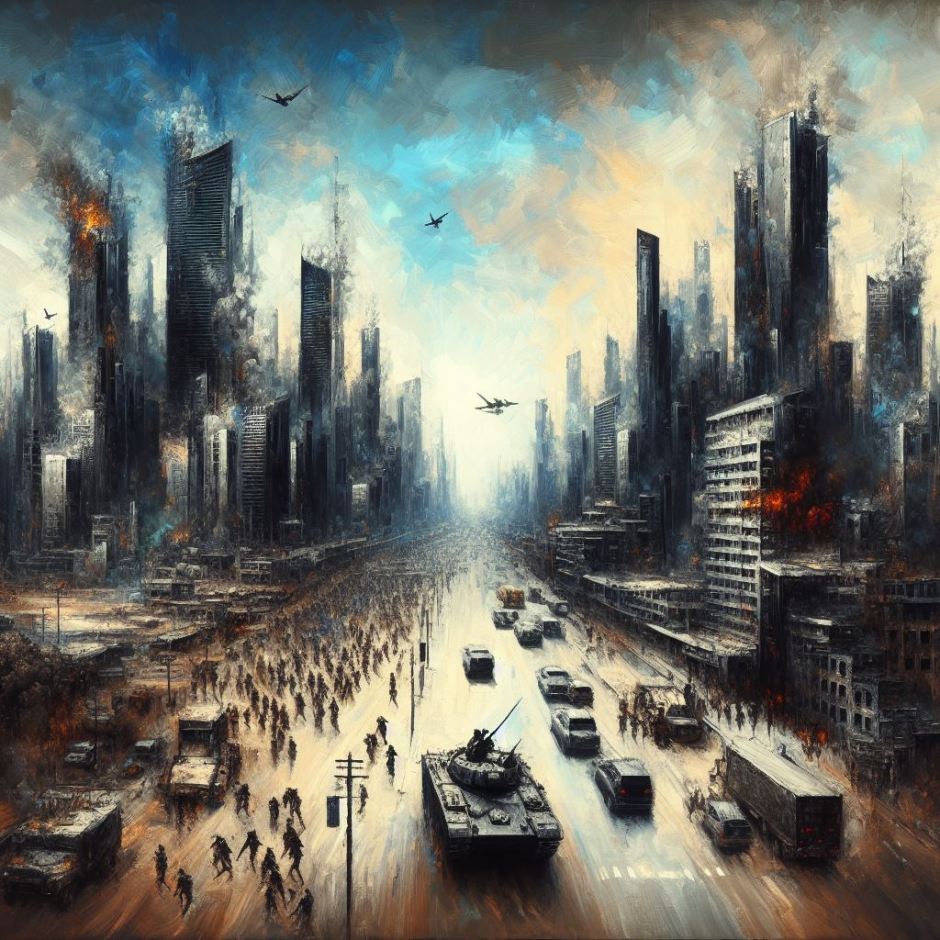
I tried to find out if there has ever been a year without war in human history, but I could not find any reliable source that answered this question conclusively. However, based on various interactive maps, timelines, and articles, I am inclined to say that there were none. With regret, I have to say that we are not a peace-loving species—more like bloodthirsty monsters. And what worries me the most is that, with time, the situation might only get worse as our global population grows, while at the same time resources become depleted and climate change of our own making makes more and more places barely habitable. Add to that all the madmen in power who try to impose their delusional vision of history or morality, and you have a deadly cocktail ready to blow.

Journal (Forever)

How long is forever? Wait, did I just wake up to ask this question, or did the question wake me up? All I know is that every time I open my eyes unexpectedly in the middle of the night, the time stretches on forever, although I’m not sure if this time it actually was about time. Anyway, I remember when I was a little boy, like a member of some primitive tribe whose numeral system was limited to one and many, “now” was the only tangible idea that I could understand. So “forever” was anything other than this instant. But I guess that’s something common for all children. With time, we all overcome this little shortcoming and forever move to a more abstract conceptual realm, unless, of course, we use it in some metaphorical way, as when we complain about having to wait forever for a loved one to call. There are also those who fetishize “forever” with their wet dreams about everlasting life, but they should be careful what they wish for; they just might get it. That would be nothing but the hell of paradise all over again.